
 Av. Emrah Karatay
Turkey is one of the most popular destinations for foreign real estate buyers. Foreign nationals may acquire apartments, houses, land and commercial property in most parts of the country, and a property purchase can also be the basis of a residence permit or of Turkish citizenship. At the same time, the purchase is subject to specific rules that do not apply to Turkish citizens, and mistakes made before the title deed transfer are difficult to correct afterwards. This guide explains the legal framework, the restrictions on foreign ownership, the transfer procedure, the costs and taxes, and the most common risks.
SHORT ANSWER
- Foreign real persons may acquire real estate in Turkey under Article 35 of the Land Registry Law No. 2644, within the limits set by law and Presidential decisions.
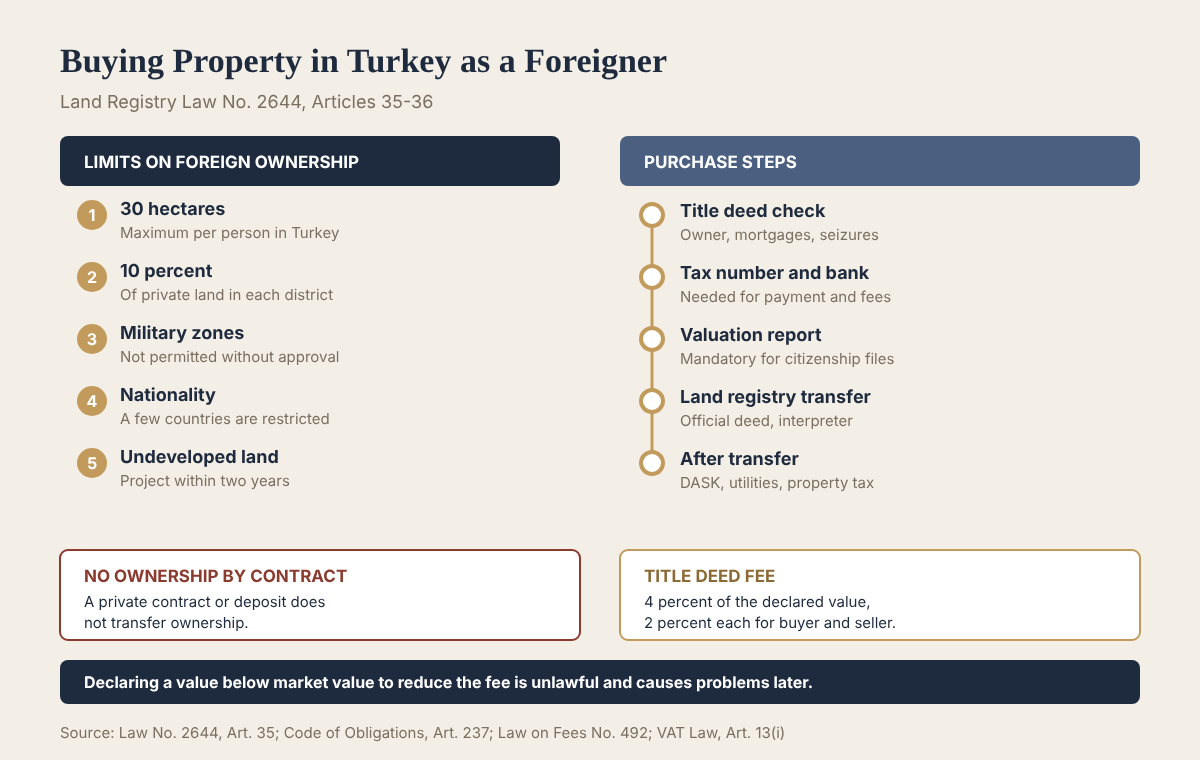
- A foreign person may own at most 30 hectares in total in Turkey, and foreigners together may own at most 10 percent of the private land in each district.
- Property in military forbidden zones and security zones cannot be acquired without permission.
- Ownership passes only by registration at the land registry office; a private contract or a deposit does not transfer ownership.
- The title deed fee is 4 percent of the declared value, normally shared equally by buyer and seller.
- Before paying, the buyer should check the title deed, zoning status, encumbrances, building permits and occupancy certificate.
Who may buy property in Turkey?
Article 35 of Land Registry Law No. 2644 regulates the acquisition of real estate by foreigners. Following the amendments made by Law No. 6302 in 2012, the reciprocity requirement was replaced by a system in which the President determines the countries whose nationals may acquire real estate and limited real rights in Turkey, taking into account the interests of the country. In practice, nationals of most countries may buy property. Nationals of a small number of countries are not permitted to acquire, or may acquire only subject to additional conditions. Syrian nationals, for example, cannot acquire real estate in their own names. Whether a particular nationality is affected should be checked with the land registry office before any payment is made.
Companies established abroad under foreign law may acquire real estate in Turkey only within the scope of special laws, such as the tourism and industrial zone legislation. Companies established in Turkey with foreign capital may acquire real estate for their activities under Article 36 of Law No. 2644, subject to a permission procedure administered by the governorships.
Limits on foreign ownership
Land Registry Law No. 2644, Article 35 (summary)
Foreign real persons may acquire real estate and limited real rights in Turkey for residence or business purposes, provided that the total area owned by a foreign person throughout the country does not exceed 30 hectares and the total area of real estate and limited real rights acquired by foreigners does not exceed 10 percent of the area of the district subject to private ownership. The President is authorised to determine the countries whose citizens may acquire real estate, and to increase the 30 hectare limit up to twice its amount.
- 30 hectares: a foreign person may own at most 30 hectares (300,000 square metres) of real estate across Turkey. The President may raise this limit up to 60 hectares.
- 10 percent per district: the total area of private property owned by foreigners in each district may not exceed 10 percent. If the quota is full, further acquisitions by foreigners in that district are refused.
- Military and security zones: real estate in military forbidden zones and military security zones under Law No. 2565 cannot be acquired by foreigners, and acquisitions in strategic areas require prior approval of the military authorities.
- Undeveloped land: a foreigner who buys undeveloped land must submit a project for its development to the relevant ministry within two years. If the project is not submitted, the land may be liquidated.
Step-by-step: how the purchase works
1. Preliminary legal checks
The single most important step is to check the property before signing anything or paying a deposit. A lawyer can obtain the land registry record (tapu kaydı) and verify:
- who the registered owner is, and whether the seller is authorised to sell (for example, whether all co-owners consent);
- whether there are mortgages, seizures (haciz), annotations of lawsuits, rights of first refusal or other encumbrances;
- whether the property is registered as a completed building with condominium ownership (kat mülkiyeti), or only as construction servitude (kat irtifakı) or as land;
- whether the building has an occupancy permit (iskan) and complies with its building permit, since illegal additions may result in demolition orders and administrative fines;
- the zoning status at the municipality, including any expropriation or urban renewal plans;
- debts relating to the property, such as unpaid property tax or service charges.
2. Tax number and bank account
The buyer obtains a Turkish tax identification number from a tax office and opens a bank account in Turkey. These are needed for payment, the title deed fee and future property tax.
3. Sale contract or preliminary contract
Under Article 237 of the Turkish Code of Obligations No. 6098, a contract for the sale of real estate is valid only if made in official form, which in practice means at the land registry office. A promise to sell (satış vaadi sözleşmesi) may be made before a notary. A simple private contract signed at an estate agent’s office does not transfer ownership and does not entitle the buyer to demand registration; at most, it may support a claim for the return of the money paid. For off-plan property, the buyer should insist on a notarised promise to sell, registered (annotated) on the land registry record, and should check the developer’s building permit and guarantees.
4. Valuation report
For purchases made in connection with an application for Turkish citizenship, a valuation report prepared by a valuation firm licensed by the Capital Markets Board is mandatory. For other purchases by foreigners, the land registry office may still ask for a valuation report depending on the applicable circular, and the buyer should confirm this when booking the appointment. A valuation report is in any case advisable, since it shows whether the price is reasonable and is required for a property-based residence permit.
5. Title deed transfer
The transfer application is made through the electronic land registry system (Web Tapu) or at the land registry office, and an appointment is given. At the appointment, the seller and the buyer, or their representatives with a power of attorney, sign the official deed before the land registry officer. A buyer who does not speak Turkish must be accompanied by a sworn interpreter. Powers of attorney issued abroad must be apostilled or legalised, translated and approved by a notary in Turkey; they must specifically authorise the purchase of real estate in Turkey.
6. After the transfer
After registration, the buyer should take out compulsory earthquake insurance (DASK) if it has not already been arranged, transfer the electricity, water and gas subscriptions, register with the municipality for property tax, and register the address with the civil registry if the property will be used as a residence.
Costs and taxes
| Item | Amount | Who pays |
|---|---|---|
| Title deed fee (tapu harcı) | 4 percent of the declared value (2 percent for each party) | Buyer and seller, unless otherwise agreed |
| Revolving fund fee (döner sermaye) | Fixed amount set annually | Buyer |
| Valuation report | Depends on the valuation company | Buyer |
| Sworn interpreter and notary | Depends on the service | Buyer |
| Compulsory earthquake insurance (DASK) | Depends on the area and the construction type | Owner |
| Annual property tax (emlak vergisi) | 0.1 to 0.6 percent of the tax value depending on the property type and location | Owner |
| VAT on new property | Depends on the property; exemption may apply to first sale to a non-resident foreigner paid in foreign currency | Buyer |
The declared value must not be lower than the property’s current market value. Declaring a lower value to reduce the title deed fee is unlawful and exposes both parties to tax assessments and penalties. It also creates problems for the buyer later, for example when applying for citizenship or when calculating capital gains tax on resale.
Under Article 13(i) of the Value Added Tax Law No. 3065, the first delivery of a residence or office to a foreign person who is not resident in Turkey may be exempt from VAT if the price is paid in foreign currency brought into Turkey and certain other conditions are met. If the property is sold within one year, the exempted VAT becomes payable. The conditions are technical and should be checked with a tax adviser before signing.
When the property is sold, income tax may be due on the capital gain if the sale takes place within five years of acquisition. Rental income is taxable in Turkey and must be declared through an annual income tax return.
Common risks for foreign buyers
Paying before the title deed transfer
Many disputes start with a large deposit paid to an estate agent or a developer before the title deed transfer. If the seller then refuses to transfer, the buyer has to sue for the return of the money, and recovery depends on the seller’s assets. Deposits should be limited, paid only after legal checks, and documented in writing.
Off-plan purchases
Off-plan purchases carry the risk that the developer does not complete the project, does not obtain an occupancy permit, or sells the same unit to more than one buyer. For consumers, Articles 40 to 46 of the Consumer Protection Law No. 6502 provide specific rules for pre-sale (ön ödemeli konut satışı) contracts, including the requirement of a notarised contract and the right to withdraw within fourteen days.
Price in foreign currency
Presidential Decree No. 32 on the Protection of the Value of the Turkish Currency restricts agreements between residents of Turkey that set the sale price of real estate in foreign currency. The rules differ depending on whether the buyer is resident in Turkey. The contract price and payment structure should therefore be checked with a lawyer.
Misrepresented status
Properties are sometimes marketed as “eligible for citizenship” or “eligible for residence” when they do not meet the value requirements, or as “with occupancy permit” when the permit has not been issued. These claims should be verified independently.
Residence and citizenship through property
Owning residential property is a ground for a short-term residence permit. For property acquired after 16 October 2023, the value must be at least USD 200,000 according to a valuation report. Property worth at least USD 400,000 can be the basis of an application for Turkish citizenship, subject to a three-year sale restriction. These routes are explained in our guides on residence permits in Turkey and Turkish citizenship by investment.
Frequently asked questions
Can a foreigner buy property in Turkey without visiting the country?
Yes. The purchase can be completed through a lawyer or another representative holding a notarised power of attorney that specifically authorises the purchase. A power of attorney issued abroad must be apostilled or legalised and translated.
Is a contract signed with an estate agent enough to make me the owner?
No. Ownership of real estate in Turkey passes only by registration at the land registry office. A private contract does not transfer ownership.
Can I pay the price in euros or dollars?
Payment may be made in foreign currency in certain circumstances, but contracts between residents of Turkey are subject to restrictions under Decree No. 32. For citizenship applications, the foreign currency must be sold to a Turkish bank and documented.
Who pays the 4 percent title deed fee?
By law, 2 percent is charged to the buyer and 2 percent to the seller. The parties may agree otherwise, and in practice the buyer often pays the whole fee.
Can I inherit or leave my Turkish property to my heirs abroad?
Yes. Turkish law applies to inheritance of real estate located in Turkey, regardless of the deceased’s nationality. See our guide on inheritance in Turkey for foreigners.
Legislation: Land Registry Law No. 2644, Articles 35 and 36; Turkish Code of Obligations No. 6098, Article 237; Law No. 2565 on Military Forbidden Zones and Security Zones; Value Added Tax Law No. 3065, Article 13(i); Consumer Protection Law No. 6502, Articles 40-46; Law on Fees No. 492.
Legal assistance in Istanbul
Karatay Law Office advises and represents foreign nationals before Turkish courts, public prosecutors and administrative authorities, with an office opposite the Istanbul Courthouse (Çağlayan) in Şişli. For contact details and the areas in which we assist international clients, see our page Lawyer in Şişli, Istanbul.
Other guides for foreigners in Turkey
- Residence Permit in Turkey: Types, Requirements, Refusal and Appeal (2026 Guide)
- Turkish Citizenship by Investment: USD 400,000 Property Route and Other Options (2026)
- Deportation from Turkey: Grounds, Administrative Detention and the 7-Day Appeal
- Turkey Entry Ban and Restriction Codes (Ç-114, G-87, N-82): Meaning and How to Lift Them
- Work Permit in Turkey for Foreigners: Types, Application, Turquoise Card and 2026 Fines
- Divorce in Turkey for Foreigners and Recognition of Foreign Divorce Judgments
- Inheritance in Turkey for Foreigners: Applicable Law, Certificate of Inheritance and Taxes
- Renting in Turkey as a Foreigner: Tenant Rights, Rent Increases, Deposit and Eviction
- Arrested in Turkey as a Foreigner: Rights in Custody, Detention, Travel Bans and Deportation Risk
This article provides general information on Turkish law as of October 2026 and does not constitute legal advice. Legislation and administrative practice change frequently; legal assistance should be obtained for a specific case.