
 Av. Emrah Karatay
Turkey allows foreign investors to acquire Turkish citizenship on an exceptional basis without the long residence periods required for ordinary naturalisation. The legal basis is Article 12 of the Turkish Citizenship Law No. 5901 and Article 20 of the Regulation on the Implementation of the Turkish Citizenship Law. The most frequently used option is the purchase of real estate worth at least USD 400,000 with a commitment not to sell it for three years. This guide explains each investment option, the conditions that apply to the property route, the valuation rules as amended in September 2026, the procedure and the points at which applications most often fail.
SHORT ANSWER
- Citizenship by investment is granted by Presidential decision under Article 12(1)(b) of Law No. 5901 and Article 20 of its Implementing Regulation.
- The property route requires the acquisition of real estate worth at least USD 400,000 and an annotation in the land registry that it will not be sold for three years.
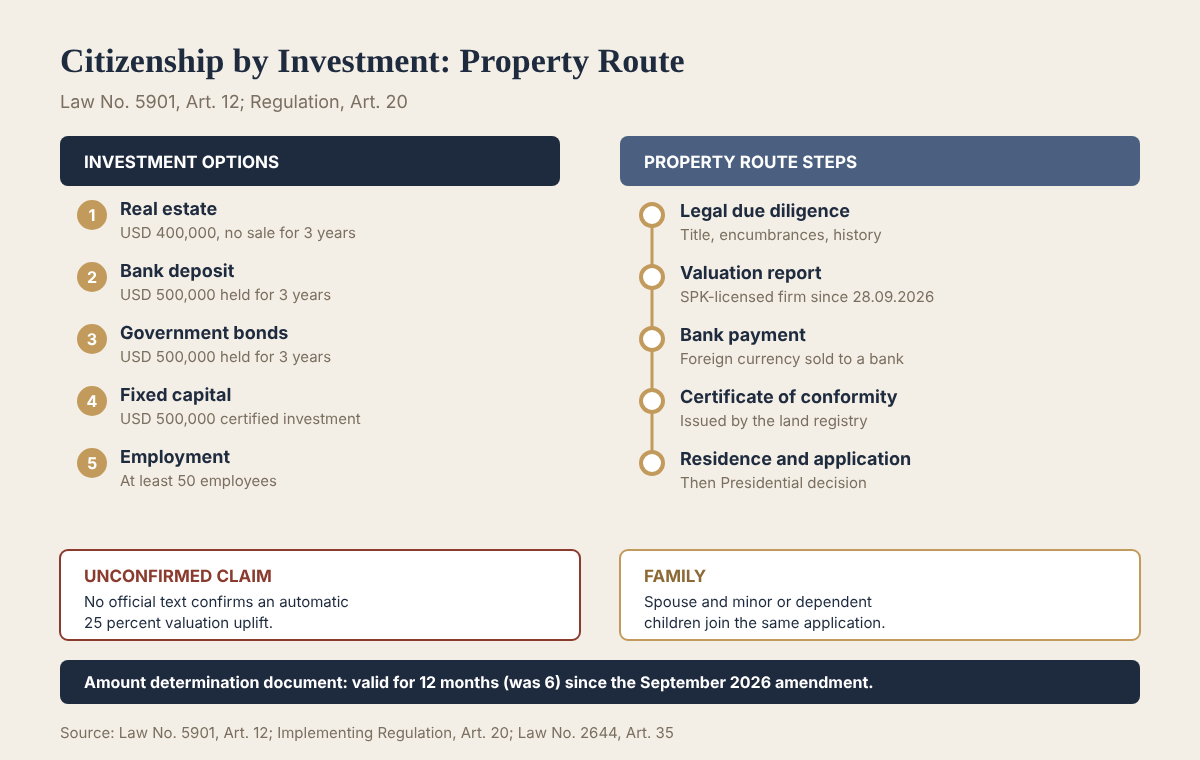
- Other options include a USD 500,000 fixed capital investment, a USD 500,000 bank deposit or government bond held for three years, fund shares and creating employment for 50 people.
- The investment must be certified by the competent authority; for property this is the General Directorate of Land Registry and Cadastre.
- From 28 September 2026 the valuation report may be prepared by any valuation firm licensed by the Capital Markets Board, and the amount determination document remains valid for twelve months.
- Spouses and minor or dependent children may be included in the same application.
Legal basis
Article 12 of Law No. 5901 lists the foreigners who may acquire Turkish citizenship by Presidential decision, provided that there is no obstacle in terms of national security and public order. Paragraph (1)(b) covers those who obtain a residence permit under Article 31(1)(j) of Law No. 6458 (the investor residence permit), holders of the Turquoise Card and their foreign spouses and minor or dependent children. The amounts and conditions of each investment are set out in Article 20 of the Implementing Regulation. The amounts are determined by the President and have been amended several times. The property threshold was raised from USD 250,000 to USD 400,000 in 2022 and remains at that level in 2026.
Law No. 5901, Article 12(1) (unofficial translation)
Provided that there is no situation constituting an obstacle in terms of national security and public order, the foreigners listed below may acquire Turkish citizenship by decision of the President: (…) b) those who have obtained a residence permit pursuant to Article 31(1)(j) of Law No. 6458 on Foreigners and International Protection dated 4/4/2013, Turquoise Card holders, and their foreign spouse, and their and their spouse’s minor or dependent foreign child.
Investment options
| Investment | Minimum amount | Certifying authority | Holding period |
|---|---|---|---|
| Fixed capital investment | USD 500,000 or equivalent | Ministry of Industry and Technology | Not specified as a sale restriction; investment must be certified |
| Real estate | USD 400,000 or equivalent | General Directorate of Land Registry and Cadastre | Three years, annotated in the land registry |
| Bank deposit | USD 500,000 or equivalent in foreign currency | Banking Regulation and Supervision Agency | Three years |
| Government debt instruments | USD 500,000 or equivalent | Ministry of Treasury and Finance | Three years |
| Real estate investment fund or venture capital fund shares | USD 500,000 or equivalent | Capital Markets Board | Three years |
| Employment | At least 50 employees | Ministry of Labour and Social Security | Employment must be certified |
The amounts and the list of options are subject to change by Presidential decision. Before committing funds, the applicant should verify that the option and amount still apply on the date of the investment.
The property route in detail
The USD 400,000 threshold
The applicant must acquire one or more immovables with a total value of at least USD 400,000 or its equivalent in foreign currency or Turkish lira. Several properties may be combined to reach the threshold. The acquisition may also be made through a notarised preliminary sale contract (promise to sell) for property under construction, provided that the contract is registered and contains an undertaking that it will not be cancelled or assigned for three years.
The decisive amount is not simply the price written in the deed. The General Directorate of Land Registry and Cadastre checks the transaction value, the valuation report and the bank records showing that the price has been paid. If the valuation report shows a value lower than the price declared, the application can be rejected even though the buyer actually paid USD 400,000.
Valuation rules after 28 September 2026
The valuation process was amended by an approval of the General Directorate of Land Registry and Cadastre dated 28 September 2026. Until then, the valuation report on which the amount determination document (tutar tespit belgesi) was issued had to be prepared by GEDAŞ, a company affiliated with the land registry administration. After the amendment, the report may be prepared by any valuation company licensed by the Capital Markets Board of Turkey. The period within which the land registry application must be made after the amount determination document is issued was extended from six months to twelve months.
During October 2026 some websites reported that 25 percent would automatically be added to the valuation figure, so that a property valued at USD 320,000 would satisfy the USD 400,000 threshold. We were unable to confirm this claim in any official text, and several practitioners report that the land registry administration denied it. Applicants should not rely on any such uplift unless it is confirmed in writing by the land registry office handling the file.
Payment and foreign currency conversion
The purchase price must be paid through a bank in Turkey and documented. Where payment is made in foreign currency, the funds must be sold to a Turkish bank and the foreign exchange purchase document (döviz alım belgesi) obtained. Payments made in cash, through third parties or outside the banking system are a frequent reason for refusal. The payment must be completed before the application for the certificate of conformity, and the transfer documents should clearly show the buyer, the seller and the property.
Restrictions on the property
- The land registry must carry an annotation that the property will not be sold, transferred or cancelled for three years.
- Property that was previously used for a citizenship application cannot be used again by another applicant.
- Under the 2022 amendments, property that has been registered in the name of a foreign person is in principle not accepted; the land registry checks the ownership history of each property.
- The seller and the buyer must not be related or connected in a way that suggests a sham transaction; transactions between relatives are examined carefully.
General restrictions on foreign ownership
The purchase must also be lawful under the general rules on acquisition of real estate by foreigners set out in Article 35 of the Land Registry Law No. 2644. These include the limit of 30 hectares per person throughout the country, the limit of 10 percent of the area of each district that may be owned by foreigners, the restrictions in military and security zones, and the list of nationalities that may acquire property in Turkey. These rules are explained in our guide on buying property in Turkey as a foreigner.
Step-by-step procedure
- Preliminary checks: title deed search, zoning status, encumbrances (mortgages, annotations, seizures), the history of ownership and whether the property was used for citizenship before.
- Tax number and bank account: the buyer obtains a Turkish tax identification number and opens an account with a Turkish bank.
- Valuation and amount determination: a valuation report is ordered from a licensed valuation company through the land registry system, and the amount determination document is issued.
- Payment and transfer: the price is paid through the bank, foreign currency is converted where required, and the title deed is transferred at the land registry office with the three-year annotation.
- Certificate of conformity: the land registry administration issues the certificate of conformity (uygunluk belgesi) confirming that the investment meets the requirements.
- Investor residence permit: the applicant obtains a short-term residence permit under Article 31(1)(j) of Law No. 6458.
- Citizenship application: the application is filed with the dedicated citizenship investment office of the provincial civil registry directorate, together with identity documents, civil status documents, the certificate of conformity and the residence permit.
- Security review and decision: the Ministry of Interior conducts a security investigation and the file is submitted for a Presidential decision. After the decision, the applicant is registered and can apply for a Turkish identity card and passport.
The processing time varies. The application to the investment office is often decided within a few months, but files can take longer when the security investigation is extended or additional documents are requested.
Family members
The foreign spouse and the minor or dependent foreign children of the investor may be included in the same application. Adult children who are not dependent must qualify on their own. Marriage and birth certificates issued abroad must be apostilled or legalised and translated by a sworn translator. If the investor is divorced, documents showing custody of minor children are usually required.
Reasons for refusal
- the valuation report or the amount determination document shows a value below USD 400,000;
- payment was not made through a bank or cannot be traced to the buyer;
- the property was previously registered to a foreigner or used in another citizenship application;
- the annotation on the land registry is missing or the three-year undertaking is defective;
- the applicant is considered a threat to national security or public order;
- documents are incomplete, inconsistent or not properly legalised.
A decision rejecting the certificate of conformity or the citizenship application can be challenged before the administrative court. Since the citizenship decision belongs to the discretion of the administration, the court primarily examines whether the reasons given are lawful and supported by facts.
Selling the property after three years
After three years the annotation can be removed and the property may be sold. The citizenship acquired is not lost as a result of the sale. If the property is sold within the three-year period in breach of the undertaking, the land registry will not allow the transfer while the annotation remains. Where citizenship has been acquired on the basis of false declarations or forged documents, Law No. 5901 allows the acquisition to be revoked.
The sale may give rise to income tax on the capital gain if the property is sold within five years of acquisition. Rental income from the property is also taxable in Turkey. An accountant should be consulted on the tax position in Turkey and in the investor’s country of residence.
Frequently asked questions
Do I need to live in Turkey to obtain citizenship by investment?
No. There is no minimum residence requirement for exceptional citizenship by investment. The applicant must, however, obtain the investor residence permit, which is a step in the procedure.
Can I keep my original nationality?
Turkish law permits dual nationality. Whether the investor may keep the original nationality depends on the law of the country concerned.
Can I buy several apartments to reach USD 400,000?
Yes. Several immovables can be combined, provided that each is acquired within the scope of the application, each carries the three-year annotation and the total value according to the valuation reports reaches the threshold.
Can I use a mortgage to buy the property?
The full price must be paid and documented. A loan from a Turkish bank is not generally accepted for the citizenship threshold, and a mortgage on the property would conflict with the three-year undertaking.
Is the 25 percent valuation uplift real?
We could not confirm it in any official text, and practitioners report that the land registry administration denied it. The value accepted is the value established by the valuation report and the land registry review.
Can the investment be made through a company?
The property route is designed for real persons. Investment through a company raises separate issues and is not normally accepted for the property threshold.
Legislation: Turkish Citizenship Law No. 5901, Article 12; Regulation on the Implementation of the Turkish Citizenship Law, Article 20; Law No. 6458, Article 31(1)(j); Land Registry Law No. 2644, Article 35.
Legal assistance in Istanbul
Karatay Law Office advises and represents foreign nationals before Turkish courts, public prosecutors and administrative authorities, with an office opposite the Istanbul Courthouse (Çağlayan) in Şişli. For contact details and the areas in which we assist international clients, see our page Lawyer in Şişli, Istanbul.
Other guides for foreigners in Turkey
- Residence Permit in Turkey: Types, Requirements, Refusal and Appeal (2026 Guide)
- Buying Property in Turkey as a Foreigner: Legal Steps, Restrictions, Taxes and Risks
- Deportation from Turkey: Grounds, Administrative Detention and the 7-Day Appeal
- Turkey Entry Ban and Restriction Codes (Ç-114, G-87, N-82): Meaning and How to Lift Them
- Work Permit in Turkey for Foreigners: Types, Application, Turquoise Card and 2026 Fines
- Divorce in Turkey for Foreigners and Recognition of Foreign Divorce Judgments
- Inheritance in Turkey for Foreigners: Applicable Law, Certificate of Inheritance and Taxes
- Renting in Turkey as a Foreigner: Tenant Rights, Rent Increases, Deposit and Eviction
- Arrested in Turkey as a Foreigner: Rights in Custody, Detention, Travel Bans and Deportation Risk
This article provides general information on Turkish law as of October 2026 and does not constitute legal advice. Legislation and administrative practice change frequently; legal assistance should be obtained for a specific case.