
 Av. Emrah Karatay
A foreign national who wishes to work in Turkey, whether as an employee or on a self-employed basis, needs a work permit or a work permit exemption. The legal basis is the International Labour Force Law No. 6735, which entered into force in 2016, together with its Implementing Regulation. Applications are decided by the Ministry of Labour and Social Security through its Directorate General of International Labour Force. Working without a permit exposes both the employer and the foreign worker to administrative fines and may lead to the worker’s removal from Turkey. This guide explains the permit types, the application procedure, the criteria applied, the rights attached to the permit, remedies against refusal and the fines applicable in 2026.
SHORT ANSWER
- Foreigners need a work permit or a work permit exemption to work in Turkey under Law No. 6735.
- A valid work permit also counts as a residence permit (Law No. 6735, Article 12).
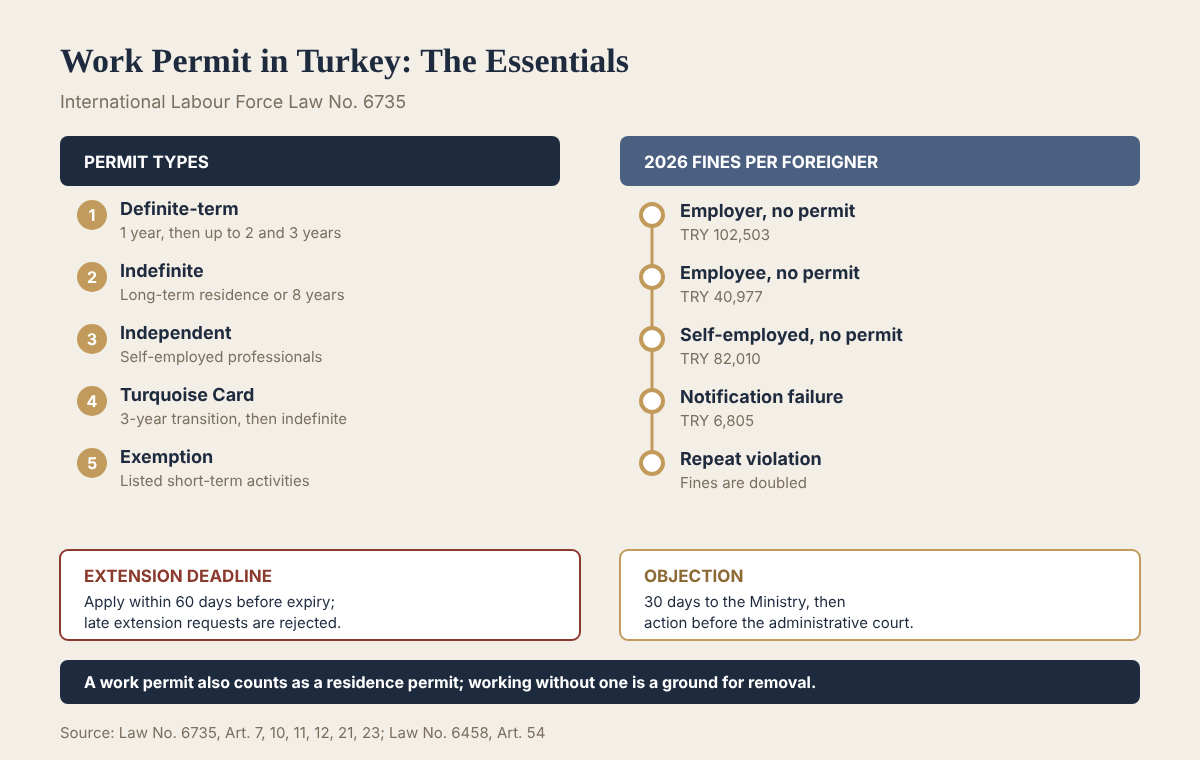
- The first permit is granted for up to one year for a specific employer; extensions with the same employer are granted for up to two years and then up to three years.
- The extension application must be filed within the sixty days before expiry and in any case before expiry; late applications are rejected.
- Refusal decisions can be challenged by objection to the Ministry within thirty days, and then before the administrative court.
- In 2026, the fine for employing a foreigner without a permit is TRY 102,503 per foreigner, and the fine for a foreigner working without a permit is TRY 40,977 for employees and TRY 82,010 for self-employed persons.
Types of work permit
| Permit | Who it is for | Duration |
|---|---|---|
| Work permit with a definite term (süreli çalışma izni) | Foreigners employed by a specific employer | First permit up to 1 year; extensions with the same employer up to 2 years, then up to 3 years |
| Indefinite work permit (süresiz çalışma izni) | Holders of a long-term residence permit, or foreigners who have worked legally in Turkey for at least eight years | Indefinite |
| Independent work permit (bağımsız çalışma izni) | Self-employed professionals meeting the education, experience and residence criteria | Set by the Ministry |
| Turquoise Card | Qualified foreigners, investors, scientists, and others meeting the criteria of the international labour force policy | Three-year transition period, then indefinite |
| Work permit exemption (çalışma izni muafiyeti) | Specific activities listed in the Regulation, such as short-term assignments, certain sports, cultural and scientific activities | Depends on the activity |
Definite-term work permit
Under Article 10 of Law No. 6735, a definite-term work permit is granted for a specific job at a specific workplace of the employer, or at its workplaces in the same line of business, for up to one year at the first application and without exceeding the term of the employment contract. If the employee changes employer, the application is assessed as a first application again.
Law No. 6735, Article 10(1)-(2) (unofficial translation)
(1) Where the application is assessed favourably, a work permit valid for a maximum of one year at the first application shall be granted to the foreigner, provided that it does not exceed the term of the employment or service contract, on condition that the foreigner works in a specific job at a specific workplace belonging to a real or legal person or a public institution, or at their workplaces in the same line of business. (2) Where an extension application made under Article 7 is assessed favourably, the foreigner shall be granted a work permit for a maximum of two years at the first extension application and up to a maximum of three years at subsequent extension applications, depending on the same employer. However, applications made to work for a different employer shall be assessed under paragraph one.
Turquoise Card
The Turquoise Card is granted under Article 11 to foreigners whose applications are considered appropriate in light of their level of education, professional experience, contribution to science and technology, and the effect of their activity or investment in Turkey on the economy and employment. The card is issued with a three-year transition period. If it is not cancelled during this period, the transition period annotation is removed on application and an indefinite Turquoise Card is issued. The holder’s foreign spouse and dependent children receive a residence permit. Turquoise Card holders and their families may also apply for Turkish citizenship under Article 12(1)(b) of Law No. 5901.
Criteria applied to applications
Applications are assessed in accordance with the international labour force policy (Article 7(4)). The Implementing Regulation and the Ministry’s evaluation criteria include, among others:
- the employer’s capital and turnover or exports, with minimum thresholds for companies;
- employment of a minimum number of Turkish citizens at the workplace for each foreign employee (in general five Turkish employees per foreign employee);
- a salary for the foreign employee that is consistent with the position and not lower than the minimum levels set for the profession, expressed as a multiple of the minimum wage;
- the education, qualifications and experience of the foreigner, and whether an equally qualified Turkish citizen is available for the job;
- for regulated professions, recognition of the diploma and, where necessary, a licence from the competent authority.
Some criteria are relaxed for foreign direct investment companies, key personnel, academic staff, domestic workers, workers in specific sectors and nationals of certain countries. A number of professions, such as practising law as an advocate, pharmacy, dentistry and some public service positions, are reserved for Turkish citizens by special laws.
For 2026 the gross monthly minimum wage is TRY 33,030. Salary thresholds for foreign employees are calculated from this amount.
How to apply
From Turkey
A foreigner who holds a valid residence permit of at least six months, other than a student residence permit, may apply from within Turkey. The employer submits the application electronically to the Ministry, and the foreigner’s documents are uploaded through the same system. Applications may also be filed by an authorised intermediary institution (Article 7(2)).
From abroad
The foreigner applies to the Turkish embassy or consulate in the country of nationality or legal residence for a work visa. The employer then completes the online application in Turkey, normally within ten working days of the consular application. If the permit is granted on the basis of an application made abroad, the foreigner must enter Turkey within six months of the start of the permit’s validity; otherwise the permit is cancelled (Article 12(2)).
Documents
The typical file contains the passport, a photograph, the employment contract, the diploma (with an equivalence document for certain professions), the employer’s trade registry documents, the latest balance sheet or profit and loss statement, and the documents showing the number of Turkish employees. Documents issued abroad must be apostilled or legalised and translated.
After the permit is granted
The employer must register the foreign employee with the Social Security Institution and start social security contributions from the start date of the permit. A notification obligation also applies when the employment ends: the employer, or a foreigner with an independent or indefinite permit, must notify the Ministry within fifteen days of the end of the work relationship or activity. Failure to notify is fined.
Extension, cancellation and rights
The extension application must be filed within the sixty days before the permit expires, and in any case before expiry (Article 7(3)). An extension application filed after expiry is rejected, and the foreigner then needs to start again with a new first application. A permit may be cancelled where it is established that the conditions for its grant no longer exist, that the foreigner does not work for the employer in the declared position, or that false documents were used.
A foreign employee with a work permit has the same rights as Turkish employees under the Labour Law No. 4857, including the minimum wage, working time rules, annual leave, severance pay and protection against unfair dismissal where the conditions are met. The absence of a work permit does not deprive a foreign worker of claims for wages and other employment rights actually earned, although enforcing them may be more difficult.
Objection and court action
Decisions refusing a work permit or cancelling it are notified under the Notification Law No. 7201. Under Article 21 of Law No. 6735, the persons concerned may object to the Ministry within thirty days of notification. If the objection is rejected, an action for annulment may be brought before the administrative court. Refusals often rely on general statements, such as the availability of Turkish workers, without assessing the specific job, and such decisions can be challenged with evidence of the employer’s needs and the candidate’s qualifications.
Fines for working without a permit (2026)
The administrative fines in Law No. 6735 are revalued each year. The amounts announced for 2026 are:
| Violation | Fine per foreigner (2026) |
|---|---|
| Employer employing a foreigner without a work permit | TRY 102,503 |
| Foreigner working as an employee without a work permit | TRY 40,977 |
| Foreigner working independently without a work permit | TRY 82,010 |
| Failure to comply with the notification obligation | TRY 6,805 |
The fines are doubled if the violation is repeated. In addition, the employer and the intermediary are liable for the costs of the foreigner’s and accompanying family members’ return to their country, and the employer is also liable for social security contributions. A foreigner found to be working without a work permit falls within the grounds for removal in Article 54 of Law No. 6458, and may receive an entry ban. See our guide on deportation from Turkey.
Frequently asked questions
Can I work in Turkey with a residence permit?
In general, no. A residence permit does not give the right to work, except for refugees and subsidiary protection beneficiaries (Law No. 6735, Article 12(1)). A work permit or exemption is required.
Can I change employer with my work permit?
The definite-term work permit is tied to the employer. A new employer must file a new application, which is assessed as a first application.
What happens to my residence if my work permit ends?
Since the work permit replaces the residence permit, its end also ends the right to reside on that basis. The foreigner must obtain another residence permit or leave Turkey within the legal period.
Can I work remotely for a foreign company while living in Turkey?
Remote work for a foreign employer while residing in Turkey raises questions of tax residence, social security and the scope of the work permit rules. A digital nomad visa programme has been announced by the authorities for certain nationalities, but its conditions are separate and should be checked before relying on it.
How long does a work permit application take?
The Ministry aims to decide within thirty days of a complete application. Missing documents and requests for additional information extend this period.
Legislation: International Labour Force Law No. 6735, Articles 7, 10, 11, 12, 21, 22 and 23; Implementing Regulation on Law No. 6735; Law No. 6458, Article 54; Labour Law No. 4857; Turkish Citizenship Law No. 5901, Article 12.
Legal assistance in Istanbul
Karatay Law Office advises and represents foreign nationals before Turkish courts, public prosecutors and administrative authorities, with an office opposite the Istanbul Courthouse (Çağlayan) in Şişli. For contact details and the areas in which we assist international clients, see our page Lawyer in Şişli, Istanbul.
Other guides for foreigners in Turkey
- Residence Permit in Turkey: Types, Requirements, Refusal and Appeal (2026 Guide)
- Turkish Citizenship by Investment: USD 400,000 Property Route and Other Options (2026)
- Buying Property in Turkey as a Foreigner: Legal Steps, Restrictions, Taxes and Risks
- Deportation from Turkey: Grounds, Administrative Detention and the 7-Day Appeal
- Turkey Entry Ban and Restriction Codes (Ç-114, G-87, N-82): Meaning and How to Lift Them
- Divorce in Turkey for Foreigners and Recognition of Foreign Divorce Judgments
- Inheritance in Turkey for Foreigners: Applicable Law, Certificate of Inheritance and Taxes
- Renting in Turkey as a Foreigner: Tenant Rights, Rent Increases, Deposit and Eviction
- Arrested in Turkey as a Foreigner: Rights in Custody, Detention, Travel Bans and Deportation Risk
This article provides general information on Turkish law as of October 2026 and does not constitute legal advice. Legislation and administrative practice change frequently; legal assistance should be obtained for a specific case.