
 Av. Emrah Karatay
Divorce cases involving a foreign element raise questions that do not arise in a purely domestic divorce. Can a Turkish court hear the case if neither spouse is a Turkish citizen? Which country’s law decides whether the marriage can be dissolved, who receives custody and whether maintenance is payable? And what must be done in Turkey after a divorce has been granted abroad? The answers are found in the Turkish Civil Code No. 4721, the Code of Civil Procedure No. 6100 and the Law on International Private and Procedural Law No. 5718 (in Turkish, MÖHUK). This guide explains the rules for foreign spouses, mixed marriages and Turkish citizens divorced abroad.
SHORT ANSWER
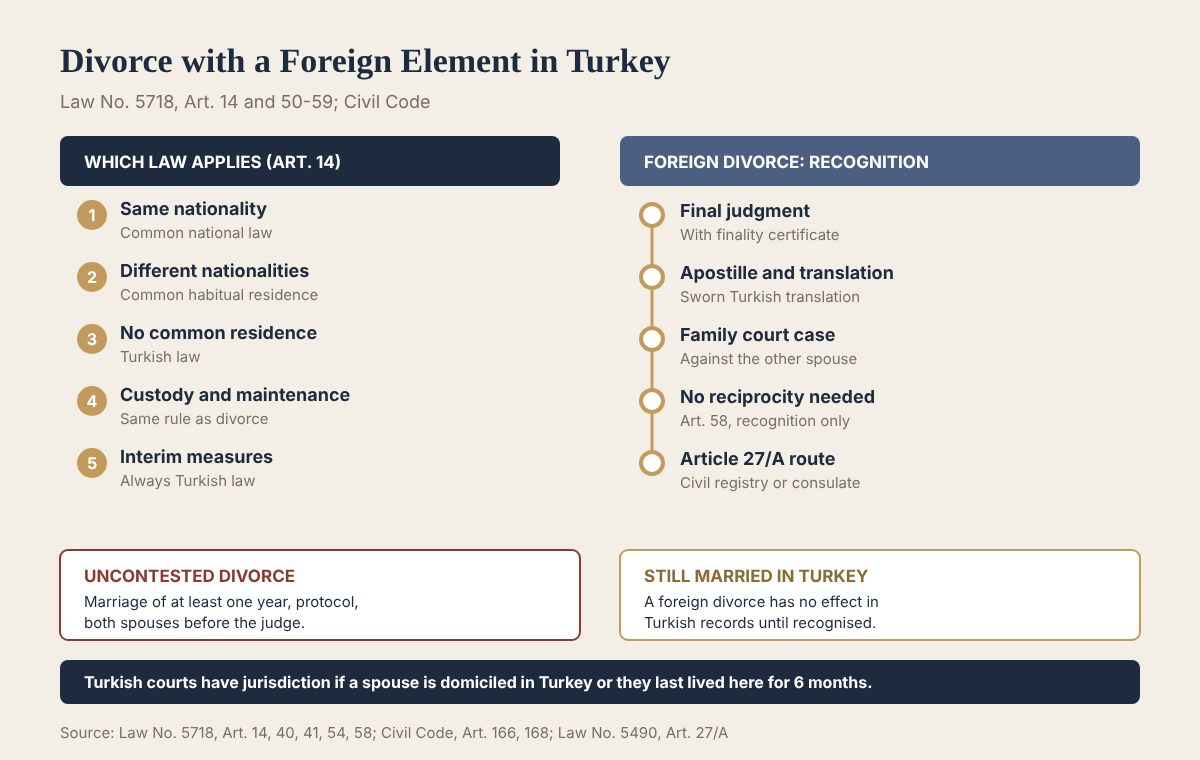
- Turkish courts have international jurisdiction over a divorce if a Turkish court would have territorial jurisdiction, for example because one of the spouses is domiciled in Turkey or the spouses last lived together in Turkey for six months.
- Under Article 14 of Law No. 5718, divorce is governed by the spouses’ common national law; if they have different nationalities, by the law of their common habitual residence; failing that, by Turkish law.
- The same law governs maintenance and custody issues arising from the divorce; interim measures are governed by Turkish law.
- Under Turkish law, an uncontested divorce is possible if the marriage has lasted at least one year and both spouses sign a protocol and appear before the judge.
- A foreign divorce judgment does not take effect in Turkey automatically; it must be recognised by a Turkish court or, in certain cases, registered administratively under Article 27/A of the Civil Registry Services Law.
- Reciprocity is not required for recognition of a foreign divorce judgment.
When can a Turkish court hear the divorce?
Under Article 40 of Law No. 5718, the international jurisdiction of Turkish courts is determined by the domestic rules on territorial jurisdiction. Under Article 168 of the Turkish Civil Code, a divorce case may be brought before the court of the place where either spouse is domiciled, or where the spouses lived together for the last six months before the case. Accordingly, a foreign couple living in Turkey, or a foreign spouse who is domiciled in Turkey, can file for divorce before the Turkish family court (aile mahkemesi), even if neither spouse is a Turkish citizen.
Article 41 of Law No. 5718 contains an additional rule for Turkish citizens: personal status cases of Turkish citizens may be heard in Turkey if they are not or cannot be brought before foreign courts. If there is no competent court by place, the case is heard by the court of the place where the person resides, or of the last domicile in Turkey, or failing that by a court in Ankara, Istanbul or Izmir.
Which law applies?
Law No. 5718, Article 14 (unofficial translation)
(1) The grounds and provisions of divorce and separation are governed by the common national law of the spouses. If the parties are of different nationalities, the law of their common habitual residence applies, and failing that, Turkish law applies. (2) The first paragraph applies to maintenance claims between divorced spouses. This rule is also valid for separation and annulment of marriage. (3) Custody and custody-related matters in divorce are also subject to the first paragraph. (4) Turkish law applies to requests for interim measures.
The rule produces the following results in practice:
| Situation | Applicable law |
|---|---|
| Both spouses have the same foreign nationality | Their common national law (for example, two German nationals: German law) |
| Different nationalities, common habitual residence in Turkey | Turkish law |
| Different nationalities, common habitual residence in another country | The law of that country |
| Different nationalities, no common habitual residence | Turkish law |
| Interim measures during the case (temporary maintenance, temporary custody, use of the home) | Turkish law |
If the applicable foreign law is clearly contrary to Turkish public policy in a particular case, for example because it does not allow a wife to divorce at all, the court may refuse to apply that provision and apply Turkish law instead (Law No. 5718, Article 5). The content of foreign law is established by the court ex officio, but in practice the parties are expected to assist by submitting the text of the law with a certified translation. Matrimonial property regimes are governed by a separate rule in Article 15, which looks first at the law chosen by the spouses and then at their common national law, common habitual residence or the law of the place where the property is located.
Divorce under Turkish law
Where Turkish law applies, the Civil Code provides for specific grounds (adultery, attempt on life or very bad treatment, commission of a crime and leading a dishonourable life, abandonment and mental illness) and a general ground of irretrievable breakdown of the marriage (Article 166).
Uncontested divorce
An uncontested divorce (anlaşmalı boşanma) is possible under Article 166(3) of the Civil Code if the marriage has lasted at least one year and the spouses apply together, or one spouse accepts the other’s application. Both spouses must appear in person before the judge, who must be satisfied that they expressed their will freely. The judge must also approve the arrangements agreed by the parties on the financial consequences of the divorce and on the position of the children. In practice the spouses sign a divorce protocol covering custody, contact with the children, child support, spousal maintenance, compensation and division of property. A foreign spouse who does not speak Turkish must be assisted by a sworn interpreter at the hearing, and the protocol is prepared in both languages where needed.
An uncontested divorce is usually concluded at the first hearing. If one spouse does not appear, or if the judge does not approve the protocol, the case continues as a contested divorce.
Contested divorce
In a contested divorce, the claimant must prove the ground relied on. For irretrievable breakdown, the court examines whether the common life has broken down so fundamentally that the spouses cannot be expected to continue it, and assesses which spouse is more at fault. The degree of fault matters for maintenance and compensation claims. Contested proceedings usually take one to two years at first instance, and the judgment can be appealed to the regional court of appeal and the Court of Cassation.
Waiting period for women
Under Article 132 of the Civil Code, a woman whose marriage has ended may not remarry until three hundred days have passed, unless she gives birth or the court lifts the waiting period, for example because she is not pregnant or the spouses remarry each other.
Custody, maintenance and children
Custody (velayet) is decided according to the best interests of the child. The court may obtain a social services report, hear the child where the child’s age and maturity allow, and regulate the other parent’s personal contact with the child, including contact across borders. Turkey is a party to the 1980 Hague Convention on the Civil Aspects of International Child Abduction. A parent who takes a child to or from Turkey in breach of the other parent’s custody rights may face return proceedings under that convention.
Child support (iştirak nafakası) and spousal maintenance (yoksulluk nafakası) are determined according to the applicable law. When Turkish law applies, spousal maintenance may be granted to the spouse who would fall into poverty because of the divorce, provided that this spouse is not more at fault. Enforcement of maintenance abroad can be pursued under the conventions to which Turkey is a party, including the 1956 New York Convention on the Recovery Abroad of Maintenance.
Divorce abroad: recognition in Turkey
A divorce judgment granted by a foreign court does not take effect in Turkey automatically. Until it is recognised, the spouses remain married according to Turkish civil registry records. This affects remarriage in Turkey, inheritance, property transactions and residence permit applications.
Recognition by a Turkish court
Under Article 58 of Law No. 5718, a foreign judgment can be accepted as conclusive evidence or res judicata if the court establishes that it satisfies the conditions of Article 54, except reciprocity. The conditions are:
- the judgment is final according to the law of the country where it was given;
- it was not given on a matter within the exclusive jurisdiction of Turkish courts, and, if the defendant objects, it was not given by a court that assumed jurisdiction without any real connection with the subject matter or the parties;
- it is not clearly contrary to Turkish public policy;
- the defendant was duly summoned and represented, and the judgment was not given in default in breach of the right of defence, if the defendant objects on that ground.
The case is brought before the family court. The claimant submits the original judgment or a certified copy, with the finality certificate, apostilled or legalised and translated into Turkish by a sworn translator. The case is filed against the other spouse, and it can also be filed through a lawyer without the claimant travelling to Turkey. Recognition cases where the defendant does not object are often concluded within a few months.
Administrative registration under Article 27/A
For Turkish citizens, Article 27/A of the Civil Registry Services Law No. 5490 allows certain foreign divorce decisions to be registered directly by the civil registry office or by the Turkish consulate, without a court case. In general the spouses must apply together, or the decision must reflect the consent of both spouses, the decision must be final and given by a competent authority, and it must not be clearly contrary to public policy. If these conditions are not met, or if a recognition case is already pending or has been rejected in Turkey, the court route must be used.
Frequently asked questions
Can two foreigners divorce in Turkey?
Yes, if a Turkish court has jurisdiction, for example because one of them is domiciled in Turkey or they last lived together in Turkey for six months. The court will apply their common national law if they share a nationality.
Can I get an uncontested divorce in Turkey quickly?
If Turkish law applies, the marriage has lasted at least one year and both spouses sign a protocol and attend the hearing, an uncontested divorce is usually granted at the first hearing.
I divorced abroad. Am I still married in Turkey?
According to Turkish records, yes, until the foreign judgment is recognised by a Turkish court or registered under Article 27/A, where available.
Do I need to be in Turkey for the recognition case?
No. A lawyer can bring the case on the basis of a power of attorney signed before a Turkish consulate or before a notary abroad with an apostille.
Is reciprocity with the foreign country required?
No. For recognition, as opposed to enforcement, reciprocity is not required (Law No. 5718, Article 58).
Legislation: Law No. 5718 on International Private and Procedural Law, Articles 5, 14, 15, 40, 41, 50-59; Turkish Civil Code No. 4721, Articles 132, 161-184; Civil Registry Services Law No. 5490, Article 27/A; 1980 Hague Convention on the Civil Aspects of International Child Abduction.
Legal assistance in Istanbul
Karatay Law Office advises and represents foreign nationals before Turkish courts, public prosecutors and administrative authorities, with an office opposite the Istanbul Courthouse (Çağlayan) in Şişli. For contact details and the areas in which we assist international clients, see our page Lawyer in Şişli, Istanbul.
Other guides for foreigners in Turkey
- Residence Permit in Turkey: Types, Requirements, Refusal and Appeal (2026 Guide)
- Turkish Citizenship by Investment: USD 400,000 Property Route and Other Options (2026)
- Buying Property in Turkey as a Foreigner: Legal Steps, Restrictions, Taxes and Risks
- Deportation from Turkey: Grounds, Administrative Detention and the 7-Day Appeal
- Turkey Entry Ban and Restriction Codes (Ç-114, G-87, N-82): Meaning and How to Lift Them
- Work Permit in Turkey for Foreigners: Types, Application, Turquoise Card and 2026 Fines
- Inheritance in Turkey for Foreigners: Applicable Law, Certificate of Inheritance and Taxes
- Renting in Turkey as a Foreigner: Tenant Rights, Rent Increases, Deposit and Eviction
- Arrested in Turkey as a Foreigner: Rights in Custody, Detention, Travel Bans and Deportation Risk
This article provides general information on Turkish law as of October 2026 and does not constitute legal advice. Legislation and administrative practice change frequently; legal assistance should be obtained for a specific case.