
 Av. Emrah Karatay
Foreign nationals who wish to stay in Turkey longer than their visa or visa-free period allows must obtain a residence permit (ikamet izni). The rules are set out in Law No. 6458 on Foreigners and International Protection (in Turkish, Yabancılar ve Uluslararası Koruma Kanunu, commonly abbreviated as YUKK) and in the Implementing Regulation adopted under it. Applications are handled by the Presidency of Migration Management (Göç İdaresi Başkanlığı) and the provincial directorates of migration management. This guide explains the main permit types, the conditions for each, the practical application process, the most frequent reasons for refusal and the legal remedies available when an application is refused or a permit is cancelled.
SHORT ANSWER
- Law No. 6458 provides six types of residence permit: short-term, family, student, long-term, humanitarian and residence permit for victims of human trafficking.
- A foreigner may stay in Turkey visa-free or with a visa only for the period allowed; a longer stay requires a residence permit.
- A valid work permit and a Turquoise Card also count as a residence permit.
- The application is filed online through the e-İkamet system and completed at an appointment with the provincial directorate.
- A refusal or cancellation can be challenged before the administrative court, normally within 60 days of notification.
- If a renewal is refused, the foreigner is generally expected to leave Turkey within ten days; remaining longer may lead to a removal decision and an entry ban.
Who needs a residence permit?
Under Article 19 of Law No. 6458, foreigners who will stay in Turkey longer than the duration of their visa, or longer than ninety days within any one hundred and eighty day period where they enter visa-free, must obtain a residence permit. The permit must be applied for before the legal period of stay expires. Staying beyond the permitted period without a residence permit is a violation of the visa or residence rules and has consequences that are explained in our guide to Deportation from Turkey and Turkey entry ban codes.
Certain documents replace the residence permit. A valid work permit issued under Law No. 6735 on International Labour Force is treated as a residence permit for its period of validity. The Turquoise Card has the same effect. Holders of an international protection status, and persons under temporary protection, are subject to a separate regime with their own identity documents.
Types of residence permit
The six permit types are listed in Article 30 of Law No. 6458. Each serves a different purpose, and applying under the wrong category is one of the most frequent causes of refusal.
| Permit type | Main purpose | Maximum duration per issue |
|---|---|---|
| Short-term | Tourism, property ownership, business connections, scientific research, medical treatment, language courses and similar purposes | Up to two years |
| Family | Spouse, minor child or dependent child of a Turkish citizen or of a foreigner holding a residence permit | Up to three years, never longer than the sponsor’s permit |
| Student | Associate, undergraduate, master’s or doctoral studies at a Turkish higher education institution | Duration of the study programme, renewed annually |
| Long-term | Foreigners who have resided in Turkey for at least eight years without interruption | Indefinite |
| Humanitarian | Exceptional situations, for example where the best interests of a child require it or removal is not possible | Up to one year, renewable |
| Victim of human trafficking | Victims of human trafficking during the recovery and cooperation period | Thirty days, renewable up to three years in total |
Short-term residence permit
The short-term residence permit is regulated by Articles 31 to 33 of Law No. 6458. Article 31 lists the grounds on which it may be granted, including coming to Turkey for scientific research, owning immovable property in Turkey, establishing business connections, attending in-service training, coming for education under international agreements or exchange programmes, staying for tourism, receiving medical treatment, attending Turkish language courses and continuing to stay after the end of a family residence permit.
Article 32 sets out the general conditions. The applicant must state a ground listed in Article 31 and submit the documents supporting it, must not fall within the scope of Article 7 (persons who are refused entry), must have accommodation that meets general health and safety standards, must submit a criminal record certificate if requested, and must give an address in Turkey. In practice the directorate also checks that the applicant has sufficient and regular financial means for the period of stay and valid health insurance.
Law No. 6458, Article 32(1) (unofficial translation)
The following conditions shall be sought in granting short-term residence permits: a) applying with one or more of the grounds listed in Article 31(1) and submitting the information and documents relating to this application; b) not falling within the scope of Article 7; c) having accommodation conditions that comply with general health and safety standards; ç) submitting, if requested, a document showing the criminal record issued by the competent authorities of the country of citizenship or legal residence; d) providing information on the address where the applicant will stay in Turkey.
For property-based applications, the property must be residential and must actually be used as a residence by the applicant. Under the amendments made to the Implementing Regulation in 2023, residential property acquired after 16 October 2023 is accepted as a basis for a short-term residence permit only if its value is at least USD 200,000. The value is determined by a valuation report rather than by the price written in the title deed. Applications based on tourism are examined more strictly than before, particularly at renewal, and the directorate expects a credible explanation of why the applicant wishes to remain in Turkey.
The Presidency of Migration Management also applies a policy of closed neighbourhoods. In districts and neighbourhoods where the proportion of foreign residents exceeds a set ratio, first-time short-term and family residence permit applications for a new address are not accepted. The list changes from time to time and should be checked before signing a lease or buying property for residence purposes.
Family residence permit
Under Article 34 of Law No. 6458, a family residence permit may be granted to the foreign spouse, the minor foreign child and the dependent foreign child of a Turkish citizen, of a foreigner holding a residence permit, or of a refugee or subsidiary protection beneficiary. It is granted for up to three years at a time and may never exceed the duration of the sponsor’s own permit. Where the national law of the person allows more than one spouse, only one spouse can obtain a family residence permit.
Article 35 requires the sponsor to show a monthly income in total not less than the minimum wage, calculated so that the income per family member is not less than one third of the minimum wage, together with accommodation, health insurance covering all family members and a clean criminal record for offences against the family. The sponsor must normally have resided in Turkey with a residence permit for at least one year. For 2026, the gross monthly minimum wage is TRY 33,030 and the net monthly minimum wage is TRY 28,075.50. Marriages are examined closely: if a marriage is concluded solely to obtain a residence permit, the permit is refused or cancelled under Article 37.
Student residence permit
Foreigners admitted to an associate, undergraduate, master’s or doctoral programme in Turkey obtain a student residence permit under Article 38. The permit covers the duration of the education and is normally renewed annually on the basis of an updated student certificate. Students enrolled in associate, undergraduate, master’s or doctoral programmes may work subject to a work permit, with restrictions during the first year of associate and undergraduate studies.
Long-term residence permit
Under Article 42, a long-term (indefinite) residence permit is granted, with the approval of the Ministry of Interior, to foreigners who have resided in Turkey continuously for at least eight years with a residence permit, or who meet conditions set by the Ministry. Article 43 requires, among other things, that the applicant has not been dependent on social assistance during the last three years, has sufficient and regular income, holds valid health insurance and does not pose a threat to public order or public security. Periods spent with a student residence permit are counted as half, and periods with other residence permits are counted in full. Holders of humanitarian residence permits, refugees, conditional refugees, subsidiary protection beneficiaries and persons under temporary protection cannot move to a long-term permit.
How to apply
The application process has several stages and the details matter.
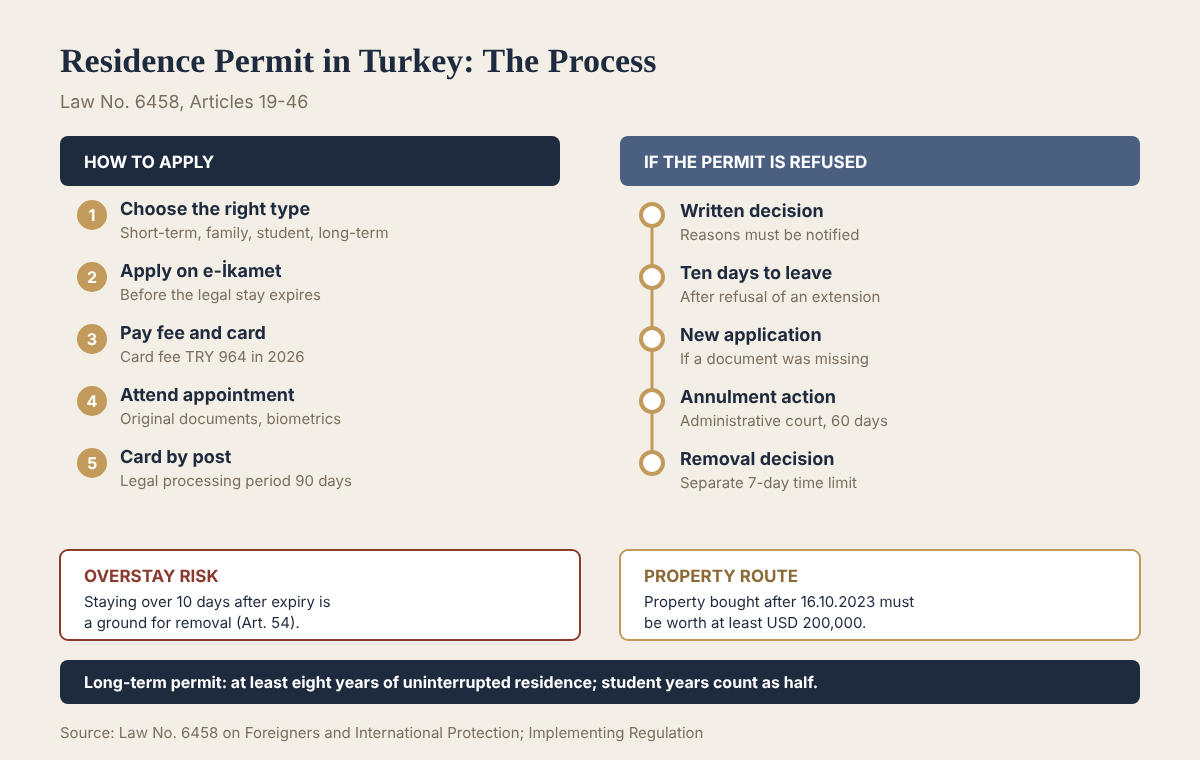
- Online form: The applicant completes the form on the e-İkamet system of the Presidency of Migration Management and selects the correct permit type. The system generates an appointment at the provincial directorate.
- Fees: The residence permit fee is calculated under the Law on Fees (Harçlar Kanunu) according to nationality, duration and reciprocity. In addition, the residence permit card fee for 2026 is TRY 964, payable on each issuance. In April 2026 reports of a sharp increase in permit fees circulated after an error in the application system; the Presidency announced on 30 April 2026 that the fees had not been changed. Students and long-term permit holders are exempt from the permit fee but not from the card fee.
- Documents: A valid passport, biometric photographs, the address registration, proof of financial means, health insurance and the documents specific to the permit type (title deed, lease agreement, marriage certificate, student certificate and so on). Documents issued abroad must be apostilled or legalised and translated by a sworn translator with notarisation.
- Appointment: The original documents are submitted at the appointment. Since the application date counts as the date of the online submission, the form should be filed before the legal stay expires. The applicant receives a residence permit application document which allows lawful stay while the application is pending.
- Decision and card delivery: If the application is approved, the residence permit card is posted to the declared address. The Presidency may ask for additional documents or invite the applicant for an interview.
Renewal (extension)
A residence permit is renewed through the same e-İkamet system. The renewal application should be filed within the sixty days before the permit expires and in any case before its expiry. Filing after expiry is treated as a new application and the period after expiry may be counted as a violation. A foreigner whose permit is renewed may stay in Turkey with the renewal application document until the new card is issued.
Under Article 33 and the corresponding provisions for other permit types, the directorate may refuse to renew a permit where the conditions are no longer met, where the permit has been used for a purpose other than the one for which it was granted, or where the foreigner has stayed outside Turkey for longer than the permitted period. For short-term permits, staying abroad for more than one hundred and twenty days in total during each year of the permit may lead to non-renewal.
Refusal, cancellation and non-renewal
A residence permit application may be refused, or an existing permit cancelled, for reasons such as the following:
- the applicant falls within one of the categories that are refused entry under Article 7;
- the declared purpose of stay is not supported by credible documents, or the permit is being used for another purpose;
- the applicant does not have sufficient and regular financial means or valid health insurance;
- the address is in a neighbourhood closed to new residence registrations;
- false information or forged documents were submitted;
- the foreigner is considered a threat to public order, public security or public health;
- a removal decision or an entry ban has been issued against the foreigner.
The decision must be notified in writing with its reasons. A refusal does not automatically mean removal from Turkey, but the foreigner whose application is refused or whose permit is not renewed is generally given ten days to leave the country. Remaining beyond that period without a lawful basis is a ground for a removal decision under Article 54 of Law No. 6458, and may lead to an entry ban.
How to challenge a refusal
A refusal, cancellation or non-renewal decision is an administrative act. It may be challenged by an action for annulment before the competent administrative court, generally within sixty days of notification under Law No. 2577 on Administrative Procedure. The claimant may also ask the court for a stay of execution. In parallel, it is often possible to submit a new application with complete documents, especially where the refusal was based on a missing document.
The court reviews whether the decision is lawful in terms of competence, form, grounds, subject and purpose. Decisions that are not reasoned, that ignore family ties in Turkey, or that rely on general statements without concrete facts are frequently annulled. Where a removal decision has been issued at the same time, the separate seven-day time limit for challenging removal applies and must not be missed.
Overstay and its consequences
A foreigner who stays beyond the visa, visa exemption or residence permit period is charged a visa or residence violation fee on exit, and may be subject to an administrative fine under Article 102 of Law No. 6458. Depending on the length of the overstay and whether the person leaves voluntarily before being detected by the authorities, an entry ban of between one month and five years may be imposed. Exceeding the visa or visa exemption period by more than ten days, and remaining for more than ten days after a residence permit has expired without an acceptable reason, are both grounds for removal under Article 54.
Frequently asked questions
Can I apply for a residence permit after my visa-free period has expired?
The application should be filed before the legal period of stay ends. A late application exposes the applicant to a violation fee and may be refused. In some cases, for example where the delay was caused by illness or another acceptable reason, the directorate may accept the application, but this is assessed individually.
Does buying property automatically give me a residence permit?
No. Ownership of residential property is a ground for applying for a short-term residence permit, but it does not create an automatic right. For property acquired after 16 October 2023 the value must be at least USD 200,000 according to a valuation report, and the other general conditions must also be met.
How long does a residence permit application take?
The legal processing period is ninety days, although many applications are decided earlier. During this period the applicant may remain in Turkey with the application document.
Can I work with a short-term residence permit?
No. A short-term residence permit does not authorise employment. Working in Turkey requires a work permit under Law No. 6735; see our guide on Work Permit in Turkey.
When can I apply for a long-term residence permit?
After at least eight years of uninterrupted residence with a residence permit, provided the other conditions in Article 43 are met. Years spent with a student permit count as half.
Can a lawyer file and follow the application for me?
A lawyer can prepare and file the application, follow it with the directorate and, where necessary, bring an action before the administrative court. The applicant’s personal attendance may still be required for the appointment and biometric data.
Legislation: Law No. 6458 on Foreigners and International Protection, Articles 7, 19, 30-46, 54 and 102; Implementing Regulation on Law No. 6458; Law No. 2577 on Administrative Procedure, Article 7.
Legal assistance in Istanbul
Karatay Law Office advises and represents foreign nationals before Turkish courts, public prosecutors and administrative authorities, with an office opposite the Istanbul Courthouse (Çağlayan) in Şişli. For contact details and the areas in which we assist international clients, see our page Lawyer in Şişli, Istanbul.
Other guides for foreigners in Turkey
- Turkish Citizenship by Investment: USD 400,000 Property Route and Other Options (2026)
- Buying Property in Turkey as a Foreigner: Legal Steps, Restrictions, Taxes and Risks
- Deportation from Turkey: Grounds, Administrative Detention and the 7-Day Appeal
- Turkey Entry Ban and Restriction Codes (Ç-114, G-87, N-82): Meaning and How to Lift Them
- Work Permit in Turkey for Foreigners: Types, Application, Turquoise Card and 2026 Fines
- Divorce in Turkey for Foreigners and Recognition of Foreign Divorce Judgments
- Inheritance in Turkey for Foreigners: Applicable Law, Certificate of Inheritance and Taxes
- Renting in Turkey as a Foreigner: Tenant Rights, Rent Increases, Deposit and Eviction
- Arrested in Turkey as a Foreigner: Rights in Custody, Detention, Travel Bans and Deportation Risk
This article provides general information on Turkish law as of October 2026 and does not constitute legal advice. Legislation and administrative practice change frequently; legal assistance should be obtained for a specific case.