
 Av. Emrah Karatay
A removal decision, commonly called a deportation decision or “deport” order, requires a foreign national to leave Turkey and is usually followed by an entry ban. The decision is taken by the governorship and can be enforced quickly, often while the foreigner is held in a removal centre. The time limit for challenging it in court is only seven days from notification. This guide explains on which grounds a removal decision may be taken, who is protected from removal, how administrative detention works, how to bring the case before the administrative court and what happens after removal.
SHORT ANSWER
- Removal decisions are regulated by Articles 52 to 60 of Law No. 6458 on Foreigners and International Protection.
- The grounds for removal are listed exhaustively in Article 54; examples include overstaying a visa by more than ten days, working without a permit and posing a threat to public order or security.
- Article 55 prohibits removal of persons who would face torture or the death penalty, persons with serious health problems and certain victims.
- The foreigner, the legal representative or the lawyer may apply to the administrative court within seven days of notification.
- In principle the foreigner cannot be removed while the time limit is running or while the case is pending, unless the foreigner consents; this protection does not apply to certain security-related grounds.
- Administrative detention may last up to six months and may be extended by up to six more months; it can be challenged before the criminal judgeship of peace.
Legal framework
The removal of foreigners is regulated in Part Four of Law No. 6458 (Articles 52 to 60) and in the Implementing Regulation. Under Article 52, foreigners may be removed to their country of origin, a transit country or a third country by a removal decision. Under Article 53, the decision is taken by the governorships either on instructions from the Presidency of Migration Management or ex officio. The decision must be notified to the foreigner, the legal representative or the lawyer together with its reasons. A foreigner who is not represented by a lawyer must be informed of the result of the decision, the appeal procedures and the time limits.
Law No. 6458, Article 53(3) (unofficial translation, as amended by Law No. 7533)
The foreigner, or the legal representative or lawyer, may apply to the administrative court against the removal decision within seven days of the notification of the decision. The person applying to the court shall also notify the authority that took the removal decision of the application.
Grounds for removal (Article 54)
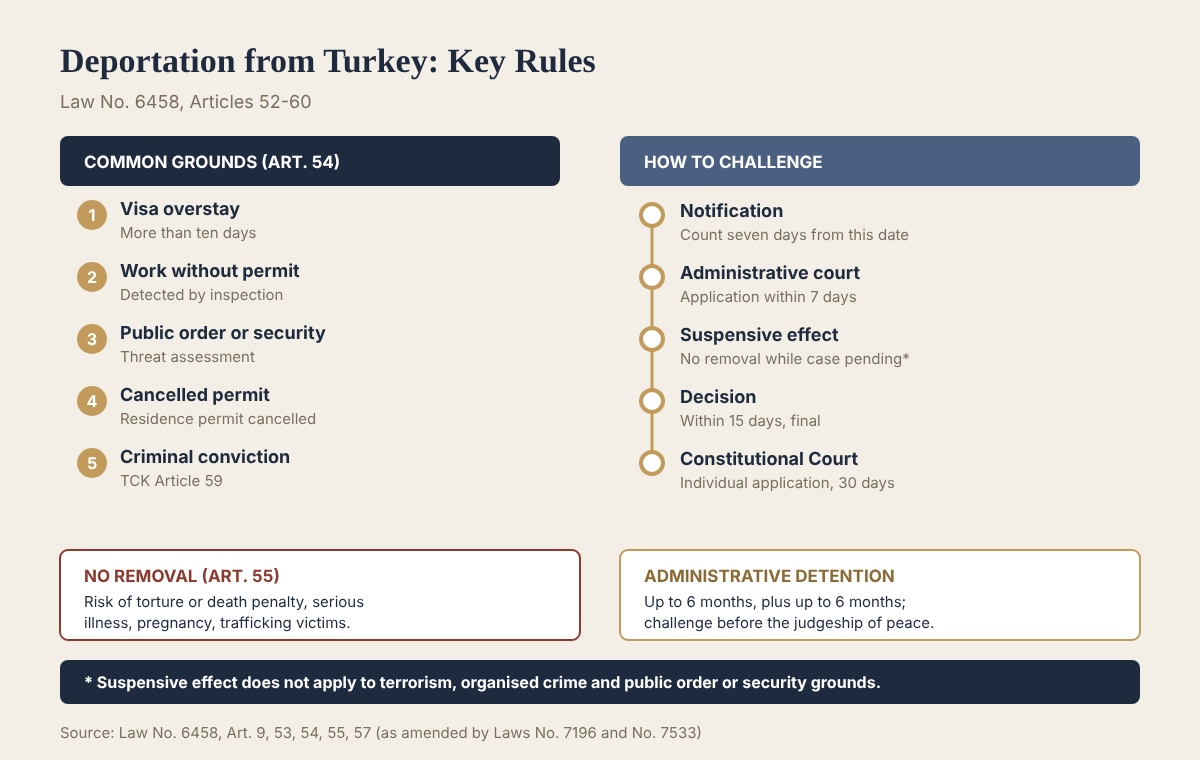
A removal decision may be taken only on one of the grounds listed in Article 54(1). The most frequently applied grounds are:
- persons whose removal is assessed as necessary under Article 59 of the Turkish Criminal Code (foreigners convicted of a crime);
- leaders, members or supporters of a terrorist organisation or of a profit-oriented criminal organisation;
- persons who used false information or forged documents in entry, visa or residence permit procedures;
- persons earning their living by illegitimate means during their stay in Turkey;
- persons who pose a threat to public order, public security or public health;
- persons who exceed the visa or visa exemption period by more than ten days, or whose visa is cancelled;
- persons whose residence permits have been cancelled;
- residence permit holders who overstay the expiry of the permit by more than ten days without an acceptable reason;
- persons found to be working without a work permit;
- persons who violate the rules on legal entry into or exit from Turkey, or who enter Turkey despite an entry ban;
- persons whose international protection applications are rejected or excluded, where they are not otherwise entitled to stay;
- persons who fail to leave Turkey within ten days after their application for a residence permit extension is refused;
- persons who are reported by international institutions and organisations to be associated with terrorism.
Under Article 54(2), a removal decision may also be taken during the international protection process against applicants or status holders in narrowly defined cases, such as membership of a terrorist organisation or a final conviction for a serious crime.
Persons who cannot be removed (Article 55)
Even if one of the grounds in Article 54 exists, Article 55 prohibits a removal decision against:
- persons for whom there are serious indications that they would be subjected to the death penalty, torture, or inhuman or degrading treatment or punishment in the country to which they would be removed;
- persons for whom travel is risky due to serious health problems, age or pregnancy;
- persons who would not have access to treatment in the country of removal while being treated for a life-threatening illness;
- victims of human trafficking benefiting from the victim support process;
- victims of psychological, physical or sexual violence, until their treatment is completed.
These assessments must be made individually for each person. In such cases the administration may impose administrative obligations, such as residing at a specific address or reporting to the authorities, instead of removal. Article 55 is also an expression of the principle of non-refoulement in Article 4 of the Law, and the Constitutional Court and the European Court of Human Rights examine claims of risk in the destination country with particular care.
How to challenge a removal decision
The seven-day time limit
The application must be filed with the administrative court within seven days of notification. This is a strict time limit. A case filed on the eighth day will be dismissed as time-barred, regardless of the merits. Foreigners in removal centres often receive the decision in Turkish, without a full explanation, and sometimes are asked to sign a form consenting to voluntary return. Signing such a form may waive the protection against removal while the case is pending, so it should not be signed without legal advice.
Effect of the application
Under Article 53, the foreigner is not removed during the period for applying to the court or, if the court is seized, until the proceedings are concluded, unless the foreigner consents. Since the 2019 amendments made by Law No. 7196, this suspensive effect does not apply to foreigners removed on the grounds of being leaders, members or supporters of a terrorist or criminal organisation, posing a threat to public order, public security or public health, or being associated with terrorism according to international organisations. In those cases, the foreigner may need to ask the court for a stay of execution and, if necessary, apply to the Constitutional Court or the European Court of Human Rights for an interim measure.
Court proceedings
Under Article 53(3) as rewritten by Law No. 7533 in November 2024, the court concludes the case within fifteen days, counted from the date on which the file is complete or, where an interim decision or a hearing is needed, from the completion of that step. Whether to hold a hearing is at the court’s discretion. The court’s decision is final and cannot be appealed to a higher administrative court. The Constitutional Court examined the finality rule in its decision of 30 May 2024 (E. 2024/25, K. 2024/116) and found it compatible with the Constitution. After the administrative court’s final decision, an individual application to the Constitutional Court is possible within thirty days, and it can be accompanied by a request for an interim measure where there is a risk to life or of ill-treatment.
The court examines whether the facts relied on actually fit one of the grounds in Article 54, whether the decision is properly reasoned, whether the foreigner’s family life in Turkey and the best interests of any children were considered, and whether any of the exceptions in Article 55 applies. Decisions based only on a general statement such as “threat to public security” without concrete information are frequently annulled.
Administrative detention
Under Article 57, foreigners falling within Article 54 who are apprehended by the law enforcement authorities must be reported immediately to the governorship. The governorship evaluates the case and decides on removal within forty-eight hours. Where there is a risk of absconding or disappearing, the foreigner has violated the rules of legal entry or exit, has used false or forged documents, has not left Turkey within the period granted without an acceptable reason, or poses a threat to public order, public security or public health, the governorship may order administrative detention for the purpose of removal.
Administrative detention in removal centres may not exceed six months. If removal cannot be completed because the foreigner does not cooperate or does not provide correct information or documents about the country of origin, this period may be extended by up to six months. The need for continued detention must be reviewed monthly by the governorship, and detention must end when it is no longer necessary.
The foreigner, the legal representative or the lawyer may challenge the detention decision before the criminal judgeship of peace (sulh ceza hakimliği). The judge decides within five days and the decision is final. A new application can be made if the conditions change. Following the 2019 amendments, Article 57/A provides alternatives to detention, such as residence at a specific address, reporting obligations, electronic monitoring and family-based return, which the administration should consider.
After removal: entry bans and costs
Under Article 9, foreigners who are removed from Turkey are banned from entering the country. The entry ban may last up to five years, and in cases of serious threat to public order or public security it may be extended by up to ten more years. The ban is recorded in the system with a restriction code. The foreigner may also be required to pay the costs of removal. The ban and its codes are explained in our guide on Turkey entry ban codes.
A foreigner who leaves Turkey voluntarily before a removal decision is taken, and pays any outstanding fees and fines, usually receives a shorter entry ban or none at all, depending on the length of the overstay. For this reason, early legal advice can make a substantial difference.
The code recorded after removal depends on the ground for removal. Overstay cases usually lead to Ç-101 to Ç-105, illegal entry to Ç-113, criminal proceedings to Ç-114 and unauthorised work to Ç-117. The meaning of each code and how to have it lifted are explained in our list of restriction codes and in the English guide to entry ban codes.
Practical steps when a removal decision is notified
- Note the exact date and time of notification and count seven days from that date.
- Ask for a copy of the decision and of the documents relied on.
- Do not sign a voluntary return form without understanding its effect.
- Collect evidence of family ties, residence, employment, health problems and any risk in the destination country.
- Instruct a lawyer immediately, granting a power of attorney at the removal centre if necessary.
- If detained, challenge the detention decision separately before the criminal judgeship of peace.
Frequently asked questions
How many days do I have to appeal a deportation decision in Turkey?
Seven days from the notification of the decision, by applying to the administrative court. The time limit is strict.
Can I be deported while my court case is pending?
In principle no, unless you consent. This protection does not apply where the decision is based on terrorism-related grounds, membership of a criminal organisation, or a threat to public order, public security or public health.
Can I appeal the administrative court’s decision?
No. The administrative court’s decision on a removal decision is final. An individual application to the Constitutional Court is possible within thirty days.
How long can I be held in a removal centre?
Up to six months, extendable by up to six more months if removal cannot be completed because the foreigner does not cooperate. The detention must be reviewed monthly and may be challenged before the criminal judgeship of peace.
Does marriage to a Turkish citizen prevent deportation?
Not automatically. Family ties are not listed as an absolute bar in Article 55, but they must be taken into account in assessing proportionality, and courts annul decisions that ignore them without a strong reason.
Will a deportation decision affect a future visa?
Yes. Removal is normally followed by an entry ban, and the record may also be visible to consulates when assessing a future visa application.
Legislation: Law No. 6458 on Foreigners and International Protection, Articles 4, 9, 52-60; Law No. 7196 (2019) and Law No. 7533 (2024) amending Law No. 6458; Turkish Criminal Code No. 5237, Article 59; Constitutional Court decision E. 2024/25, K. 2024/116, 30 May 2024.
Legal assistance in Istanbul
Karatay Law Office advises and represents foreign nationals before Turkish courts, public prosecutors and administrative authorities, with an office opposite the Istanbul Courthouse (Çağlayan) in Şişli. For contact details and the areas in which we assist international clients, see our page Lawyer in Şişli, Istanbul.
Other guides for foreigners in Turkey
- Residence Permit in Turkey: Types, Requirements, Refusal and Appeal (2026 Guide)
- Turkish Citizenship by Investment: USD 400,000 Property Route and Other Options (2026)
- Buying Property in Turkey as a Foreigner: Legal Steps, Restrictions, Taxes and Risks
- Turkey Entry Ban and Restriction Codes (Ç-114, G-87, N-82): Meaning and How to Lift Them
- Work Permit in Turkey for Foreigners: Types, Application, Turquoise Card and 2026 Fines
- Divorce in Turkey for Foreigners and Recognition of Foreign Divorce Judgments
- Inheritance in Turkey for Foreigners: Applicable Law, Certificate of Inheritance and Taxes
- Renting in Turkey as a Foreigner: Tenant Rights, Rent Increases, Deposit and Eviction
- Arrested in Turkey as a Foreigner: Rights in Custody, Detention, Travel Bans and Deportation Risk
This article provides general information on Turkish law as of October 2026 and does not constitute legal advice. Legislation and administrative practice change frequently; legal assistance should be obtained for a specific case.