
 Av. Emrah Karatay
Foreign nationals who own property in Turkey, foreigners married to Turkish citizens, and foreign heirs of a person who died in Turkey all face the same practical questions. Which country’s law decides who inherits? How are bank accounts and title deeds in Turkey transferred to the heirs? Is a will made abroad valid in Turkey? And what taxes are payable? The answers are found mainly in Article 20 of the Law on International Private and Procedural Law No. 5718, the Turkish Civil Code No. 4721, the Land Registry Law No. 2644 and the Inheritance and Transfer Tax Law No. 7338. This guide explains these rules and the procedure that foreign heirs follow in practice.
SHORT ANSWER
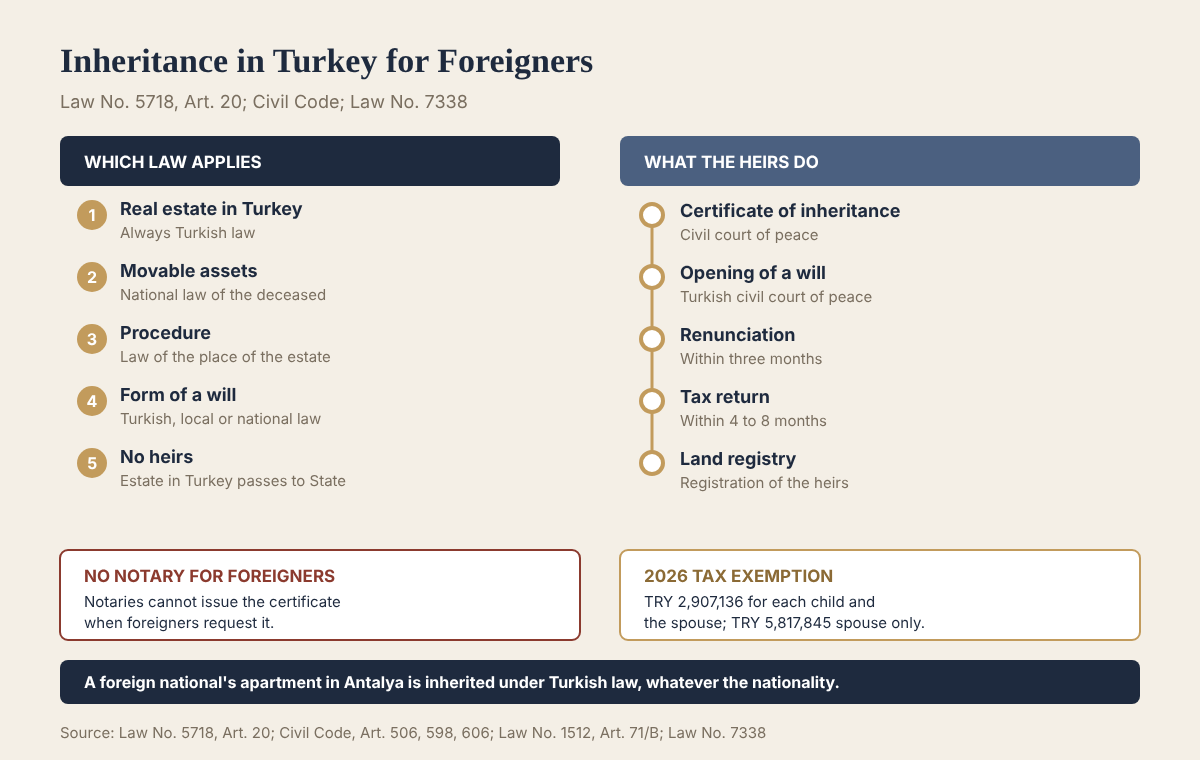
- Under Article 20 of Law No. 5718, inheritance is governed by the national law of the deceased, but Turkish law applies to immovable property located in Turkey.
- The opening, acquisition and division of the estate are governed by the law of the country where the estate is located.
- The heirs need a certificate of inheritance (mirasçılık belgesi); where foreign heirs or a foreign deceased are involved, it is issued by the civil court of peace, not by a notary.
- Under Turkish law, an heir may renounce the inheritance within three months, for example to avoid liability for the deceased’s debts.
- Inheritance and transfer tax is payable in Turkey on assets located in Turkey; for 2026, the exemption for each child and the spouse is TRY 2,907,136.
- Foreign heirs can generally inherit real estate in Turkey, subject to the restrictions in Article 35 of Law No. 2644.
Which law applies?
Law No. 5718, Article 20 (unofficial translation)
(1) Inheritance is subject to the national law of the deceased. Turkish law applies to immovables located in Turkey. (2) The provisions on the grounds for the opening of the succession, its acquisition and division are subject to the law of the country where the estate is located. (3) An estate located in Turkey without heirs passes to the State. (4) Article 7 applies to the form of dispositions mortis causa. Dispositions mortis causa made in a form complying with the national law of the deceased are also valid. (5) The capacity to make a disposition mortis causa is subject to the national law of the person making it at the time of the disposition.
This rule splits the estate in many cases:
- Real estate in Turkey: always governed by Turkish inheritance law, whatever the nationality of the deceased. If a British national dies owning an apartment in Antalya, Turkish law determines who inherits the apartment and in what shares.
- Movable assets (bank accounts, vehicles, shares, personal belongings): governed by the national law of the deceased. For a Turkish citizen, Turkish law; for a German national, German law, subject to any renvoi rules of that law.
- Procedure: the opening of the succession, the acquisition of the estate and its division follow the law of the country where the estate is located. Assets in Turkey are therefore distributed through Turkish procedures.
Turkey has also concluded bilateral consular and legal assistance agreements with several countries, some of which contain specific rules on inheritance. Where such an agreement applies, it takes precedence over Law No. 5718.
Who inherits under Turkish law?
Where Turkish law applies, the legal heirs are determined by the parentela system in the Civil Code:
- First order: the descendants of the deceased (children, and grandchildren in place of a predeceased child) inherit in equal shares.
- Second order: if there are no descendants, the parents inherit; if a parent has died, that parent’s share passes to his or her descendants.
- Third order: if there are no heirs in the first two orders, the grandparents and their descendants inherit.
- Surviving spouse: the spouse inherits together with any order of heirs. The spouse receives one quarter when inheriting with descendants, one half with the parents’ line, three quarters with the grandparents’ line, and the whole estate if there are no heirs in these orders.
Adopted children inherit from the adoptive parent like biological children. Children born outside marriage inherit from the father if paternity has been established by recognition or court decision.
Wills and forced shares
A person may dispose of the estate by will or by a contract of inheritance, within the limits of the forced shares (saklı pay). Under Article 506 of the Civil Code, the forced share of descendants is half of their legal share, that of each parent is one quarter of the legal share, and the surviving spouse’s forced share is the whole legal share when inheriting with descendants or parents and three quarters in other cases. A will that infringes forced shares is not void, but the forced heirs may bring an action for reduction (tenkis davası).
A will is formally valid in Turkey if it complies with Turkish law, with the law of the place where it was made, or with the national law of the testator (Law No. 5718, Articles 7 and 20(4)). Turkish law recognises three forms of will: the official will made before a notary or civil court judge with two witnesses, the handwritten will written entirely by hand, dated and signed by the testator, and the oral will in emergencies. A will made abroad can be used in Turkey, but it must be opened by the Turkish civil court of peace (vasiyetnamenin açılması) if it concerns assets in Turkey. The court notifies the heirs, who may then bring an action to annul it within the time limits in the Civil Code.
The certificate of inheritance
Banks, the land registry, the traffic registry and other institutions in Turkey release assets only on presentation of a certificate of inheritance (mirasçılık belgesi or veraset ilamı). The certificate states the heirs and their shares.
Under Article 598 of the Civil Code, the certificate may be issued by the civil court of peace or by a notary. Under Article 71/B of the Notaries Law No. 1512, however, a notary may not issue the certificate where it requires adjudication, where the civil registry records are insufficient, or where the certificate is requested by foreigners. In practice, any inheritance with a foreign element, such as a foreign deceased, a foreign heir, or heirs whose status depends on foreign documents, is handled by the civil court of peace (sulh hukuk mahkemesi).
The application is made to the civil court of peace and is processed as non-contentious proceedings. The court requires:
- the death certificate, and where the death occurred abroad, the foreign death certificate apostilled or legalised and translated;
- documents showing the family relationships, such as birth and marriage certificates, issued by the authorities of the country of nationality and translated;
- for a foreign deceased whose movables are governed by foreign law, the text of the relevant foreign inheritance rules with a translation;
- the identity documents of the heirs and, where a lawyer acts, a power of attorney.
The court may ask the Ministry of Foreign Affairs or the consulate for information on the foreign law. A certificate issued abroad, such as a European Certificate of Succession, is not automatically accepted by Turkish institutions; it may need to be recognised by a Turkish court, or a new Turkish certificate may need to be obtained.
Renouncing the inheritance
Under Turkish law, the heirs acquire the estate, including the debts, automatically on the death. An heir who does not wish to be liable for the deceased’s debts may renounce the inheritance (mirasın reddi) by a declaration to the civil court of peace within three months (Civil Code, Article 606). The period starts from the date on which the legal heir learned of the death, or for appointed heirs from the date of notification of the will. If the estate is clearly insolvent at the time of death, the renunciation is presumed. The time limit can be extended by the court for important reasons, which is often relevant for heirs living abroad who learn of the debts late.
Real estate inherited by foreign heirs
A foreign heir can generally inherit real estate in Turkey. The registration of the inherited property in the heirs’ names is carried out at the land registry office on the basis of the certificate of inheritance. Under Article 35 of Law No. 2644, foreign real persons may acquire real estate within the limits set by law and Presidential decisions, including the 30 hectare limit per person and the restrictions in military and security zones. Where the heir is a national of a country whose citizens may not acquire real estate in Turkey, or where a restriction applies, the property may have to be liquidated and the heir receives the proceeds. The general rules are explained in our guide on buying property in Turkey as a foreigner.
Where there are several heirs, they hold the estate jointly (elbirliği mülkiyeti) until it is divided. The heirs can agree on the division by a contract of division, convert joint ownership into shared ownership at the land registry, or ask the court to divide the property by an action for the termination of joint ownership (ortaklığın giderilmesi davası), which usually leads to a sale by auction if physical division is not possible.
Inheritance and transfer tax
Assets located in Turkey that pass by inheritance are subject to inheritance and transfer tax under Law No. 7338, regardless of the nationality of the deceased or the heirs. The heirs must file an inheritance tax return within the periods set in the law, which range from four to eight months from the death depending on where the death occurred and where the heirs live.
| Exemption (2026) | Amount |
|---|---|
| Share of each descendant (including adopted children) and of the spouse | TRY 2,907,136 |
| Share of the spouse where there are no descendants | TRY 5,817,845 |
| Gratuitous transfers such as gifts | TRY 66,935 |
The amounts above apply from 1 January 2026 under General Communiqué No. 57 on Inheritance and Transfer Tax. The part of the share above the exemption is taxed at progressive rates between 1 and 10 percent for inheritance. The tax may be paid in six instalments over three years. Before the assets can be transferred at the land registry or released by banks, a document showing that the tax return has been filed is usually required.
Heirs resident abroad may also have tax obligations in their country of residence, and double taxation agreements may be relevant, although most of Turkey’s double taxation agreements do not cover inheritance tax.
Frequently asked questions
My father was a foreign national with an apartment in Turkey. Which law applies?
Turkish law governs the apartment. His other assets in Turkey that are movable, such as bank accounts, are governed by his national law.
Can a notary in Turkey issue the certificate of inheritance for foreign heirs?
No. Where the certificate is requested by foreigners, it must be obtained from the civil court of peace.
Do I need to come to Turkey to claim the inheritance?
No. A lawyer can act on the basis of a power of attorney signed before a Turkish consulate or before a notary abroad with an apostille.
How can I avoid inheriting the deceased’s debts?
By renouncing the inheritance before the civil court of peace within three months. The court may extend the period for important reasons.
Is a will made in my home country valid for property in Turkey?
A will is formally valid if it complies with Turkish law, the law of the place where it was made, or the national law of the testator. It must be opened by a Turkish court, and Turkish forced share rules apply to real estate in Turkey.
Legislation: Law No. 5718 on International Private and Procedural Law, Articles 7 and 20; Turkish Civil Code No. 4721, Articles 495-682 (in particular 506, 598 and 606); Notaries Law No. 1512, Article 71/B; Land Registry Law No. 2644, Article 35; Inheritance and Transfer Tax Law No. 7338; General Communiqué No. 57 on Inheritance and Transfer Tax.
Legal assistance in Istanbul
Karatay Law Office advises and represents foreign nationals before Turkish courts, public prosecutors and administrative authorities, with an office opposite the Istanbul Courthouse (Çağlayan) in Şişli. For contact details and the areas in which we assist international clients, see our page Lawyer in Şişli, Istanbul.
Other guides for foreigners in Turkey
- Residence Permit in Turkey: Types, Requirements, Refusal and Appeal (2026 Guide)
- Turkish Citizenship by Investment: USD 400,000 Property Route and Other Options (2026)
- Buying Property in Turkey as a Foreigner: Legal Steps, Restrictions, Taxes and Risks
- Deportation from Turkey: Grounds, Administrative Detention and the 7-Day Appeal
- Turkey Entry Ban and Restriction Codes (Ç-114, G-87, N-82): Meaning and How to Lift Them
- Work Permit in Turkey for Foreigners: Types, Application, Turquoise Card and 2026 Fines
- Divorce in Turkey for Foreigners and Recognition of Foreign Divorce Judgments
- Renting in Turkey as a Foreigner: Tenant Rights, Rent Increases, Deposit and Eviction
- Arrested in Turkey as a Foreigner: Rights in Custody, Detention, Travel Bans and Deportation Risk
This article provides general information on Turkish law as of October 2026 and does not constitute legal advice. Legislation and administrative practice change frequently; legal assistance should be obtained for a specific case.