
 Av. Emrah Karatay
Most foreigners who live in Turkey rent their home, at least during their first years in the country. A lease agreement is also one of the key documents in a residence permit application. Turkish tenancy law gives residential tenants considerable protection, but many disputes arise because tenants are not aware of their rights, or because the lease is drafted in a way that does not reflect Turkish law. This guide explains the rules of the Turkish Code of Obligations No. 6098 on residential leases, the limit on rent increases in 2026, the security deposit, the grounds on which a landlord may evict a tenant, the mandatory mediation process and the practical points that foreign tenants should check before signing.
SHORT ANSWER
- Residential leases are governed by Articles 299 to 356 of the Turkish Code of Obligations No. 6098; the same rules apply to foreign and Turkish tenants.
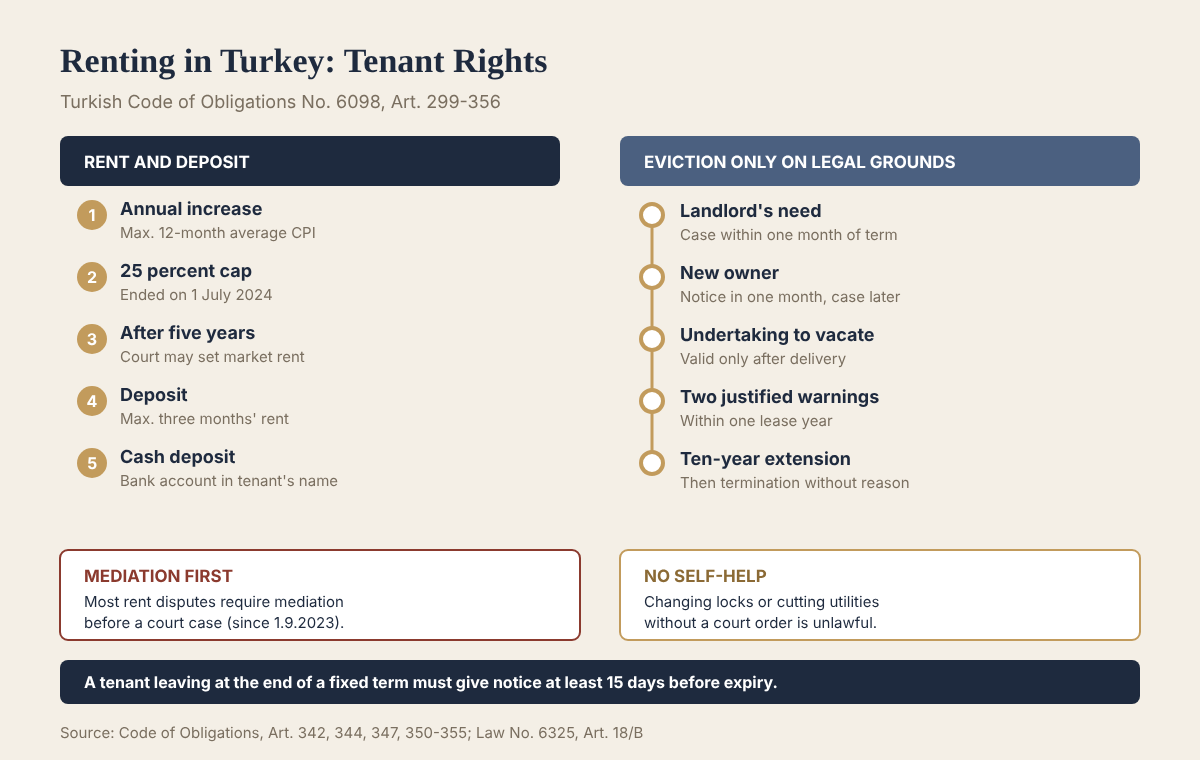
- At renewal, the rent increase may not exceed the twelve-month average change in the consumer price index (CPI); the temporary 25 percent cap ended on 1 July 2024.
- After five years, the rent can be reset by the court according to market rents.
- The security deposit may not exceed three months’ rent and, if it is in cash, must be deposited in a bank account in the name of the tenant.
- A tenant under a fixed-term lease cannot be evicted at the end of the term merely because it has expired; the landlord needs one of the legal grounds, or must wait until the end of the ten-year extension period.
- Before going to court in most rent disputes, the parties must first apply to a mediator.
The lease agreement
A residential lease does not need to be in a particular form to be valid; it can even be concluded orally. In practice, however, a written agreement is essential. The migration authorities require a lease for property-based residence addresses, and in many provinces they ask for a lease certified by a notary. A written lease is also necessary to prove the agreed rent, the deposit and the condition of the property.
A foreign tenant who does not read Turkish should obtain a translation of the lease before signing, or sign a bilingual lease. The lease should state at least:
- the identity of the landlord and the tenant, and the landlord’s ownership of the property (check the title deed);
- the address and description of the property, and the list of furniture and appliances if furnished;
- the rent, the payment date and the bank account to which it is paid;
- the term of the lease and the rule on rent increases;
- the amount of the deposit and how it will be held;
- who pays the building service charges (aidat), utilities and property tax.
Clauses that conflict with mandatory provisions of the Code of Obligations to the detriment of the tenant are void. For example, a clause requiring the tenant to pay a penalty or the rest of the rent if the lease is terminated early, or a clause allowing an increase above the CPI limit, is not enforceable to that extent.
Rent increases
Turkish Code of Obligations No. 6098, Article 344(1) (unofficial translation)
Agreements of the parties on the rent to be applied in renewed rental periods are valid provided that they do not exceed the rate of change in the consumer price index according to the twelve-month averages in the previous rental year. This rule also applies to lease agreements longer than one year.
The rules on rent increases in 2026 can be summarised as follows:
- Annual increase: at the start of each new lease year, the rent may be increased by at most the twelve-month average CPI change announced by the Turkish Statistical Institute (TÜİK) for the month before the renewal. A contractual increase above that rate is invalid to the extent of the excess.
- The 25 percent cap has ended: between June 2022 and 1 July 2024, a temporary rule limited increases on residential leases to 25 percent. That rule is no longer in force; only the CPI limit applies.
- No agreement: if the lease contains no increase clause, the rent is determined by the judge, not exceeding the CPI limit and taking into account the condition of the property.
- After five years: for leases longer than five years, or renewed after five years, and at the end of every subsequent five-year period, the judge may set the rent according to the CPI change, the condition of the property and comparable rents (Article 344(3)). This is the route landlords use to bring a long-standing rent up to market level.
- Foreign currency: if the rent is agreed in foreign currency, subject to the restrictions on foreign currency contracts between residents under the currency protection legislation, it may not be changed for five years, except in cases of hardship.
A landlord may also file a rent determination case (kira tespit davası) during the lease. Under Article 345, the rent determined by the court applies from the beginning of the new lease year if the case is filed within the new lease year, or if the landlord notified the tenant in writing at least thirty days before the end of the lease year that the rent would be increased.
Deposit
Under Article 342, the deposit may not exceed three months’ rent. If the deposit is given in cash or securities, it must be deposited with a bank in a time deposit account in the tenant’s name, and can be withdrawn only with the consent of both parties or on the basis of a final enforcement order or court judgment. If the landlord does not start enforcement proceedings or bring a case against the tenant within three months of the end of the lease, the bank must return the deposit to the tenant on the tenant’s request. In practice, many deposits are paid in cash directly to the landlord; the tenant should at least obtain a written receipt.
Ending the lease: the tenant’s side
A tenant under a fixed-term lease may leave at the end of the term by notifying the landlord at least fifteen days before its expiry (Article 347(1)). If the tenant does not give notice, the lease is renewed for one more year on the same terms. A tenant who wishes to leave before the end of the term must either find a suitable new tenant acceptable to the landlord, or remain liable for the rent until the property can reasonably be relet (Article 325). The tenant is not automatically liable for all the remaining rent.
Ending the lease: the landlord’s side
The landlord cannot terminate a residential lease merely because the fixed term has ended. Under Article 347(1), the landlord may terminate without giving a reason only after the end of a ten-year extension period, which begins at the end of the original term, by giving notice at least three months before the end of each subsequent extension year. Otherwise, the landlord must rely on one of the specific grounds in the Code of Obligations:
| Ground | Legal basis | Main condition |
|---|---|---|
| Need of the landlord or close relatives for housing | Article 350(1) | Genuine and continuing need; case filed within one month of the end of the term |
| Major renovation or reconstruction | Article 350(2) | Works that make use of the property impossible |
| Need of a new owner | Article 351 | Written notice within one month of acquisition; eviction case after six months |
| Written undertaking to vacate | Article 352(1) | Undertaking signed after the property was delivered, with a specific date |
| Two justified warnings for non-payment | Article 352(2) | Two justified written warnings within one lease year (for leases of one year or more) |
| Tenant or spouse owns a home in the same district | Article 352(3) | Landlord was unaware at the time of the lease |
| Default in payment | Article 315 and Enforcement and Bankruptcy Law No. 2004 | Written notice with a period of at least thirty days, then termination or enforcement |
The tenant should be very careful about signing an undertaking to vacate (tahliye taahhüdü). An undertaking signed at the time the lease was concluded, before the property was delivered, is invalid. Landlords sometimes ask for undated undertakings at the beginning of the lease; this practice is contrary to the law, but it creates difficult evidential questions if a dispute arises.
A landlord who evicts a tenant on the ground of need, or for renovation, may not rent the property to anyone other than the former tenant for three years without a justified reason (Article 355). If the landlord breaches this rule, the former tenant can claim compensation of at least one year’s rent.
The landlord may not change the locks, cut off utilities or remove the tenant’s belongings without a court judgment or an enforcement order. Such conduct may constitute a criminal offence and gives rise to a claim for damages.
Mandatory mediation
Since 1 September 2023, mediation has been a mandatory precondition for court proceedings in disputes arising from leases, under Article 18/B of the Law on Mediation in Civil Disputes No. 6325. This covers, among others, rent determination cases, claims for unpaid rent and many eviction cases. The claimant must first apply to the mediation office of the courthouse. If the parties agree, the mediator’s signed settlement has the effect of a court judgment. If they do not agree, the claimant may file the case with the final minutes of the mediation. Eviction proceedings through the enforcement office for unpaid rent, and certain other enforcement routes, are not subject to mandatory mediation.
A foreign party can take part in mediation through a lawyer or with the assistance of an interpreter. The mediator can also hold sessions online.
Practical points for foreign tenants
- Verify that the person signing the lease is the owner or is authorised by the owner; ask to see the title deed and the owner’s identity.
- Pay rent by bank transfer with a clear description, and keep the receipts.
- Photograph the property and its contents on moving in, and note existing damage in the lease or in a separate handover document.
- Register your address with the civil registry within twenty working days of moving in; the address registration is needed for the residence permit.
- Check whether the address is in a neighbourhood closed to new residence permit registrations; see our guide on residence permits in Turkey.
- Keep a copy of the lease in a language you understand, and ask for a notarised lease if it is required for your residence application.
Frequently asked questions
How much can my landlord increase the rent in 2026?
At the start of the new lease year, by no more than the twelve-month average CPI change for the month before the renewal. The 25 percent cap ended on 1 July 2024.
My lease has ended. Can my landlord force me to leave?
Not merely because the term has ended. The landlord needs a legal ground, such as genuine personal need or two justified warnings, or must wait until the end of the ten-year extension period.
My landlord will not return my deposit. What can I do?
If the deposit is in a bank account in your name, the bank must return it if the landlord does not start proceedings within three months after the lease ends. If it was paid in cash, you can claim it back, first through mandatory mediation and then in court.
Is a lease in English valid in Turkey?
Yes, a lease is valid regardless of the language. However, official authorities and courts will require a sworn Turkish translation, and the migration directorate may request a notarised lease.
Can I leave before the end of my lease?
Yes, but you remain liable for the rent until the property can reasonably be relet, unless you propose a suitable new tenant whom the landlord can reasonably be expected to accept.
Legislation: Turkish Code of Obligations No. 6098, Articles 299-356 (in particular 315, 325, 342, 344, 345, 347, 350-355); Law on Mediation in Civil Disputes No. 6325, Article 18/B; Enforcement and Bankruptcy Law No. 2004, Articles 269-276.
Legal assistance in Istanbul
Karatay Law Office advises and represents foreign nationals before Turkish courts, public prosecutors and administrative authorities, with an office opposite the Istanbul Courthouse (Çağlayan) in Şişli. For contact details and the areas in which we assist international clients, see our page Lawyer in Şişli, Istanbul.
Other guides for foreigners in Turkey
- Residence Permit in Turkey: Types, Requirements, Refusal and Appeal (2026 Guide)
- Turkish Citizenship by Investment: USD 400,000 Property Route and Other Options (2026)
- Buying Property in Turkey as a Foreigner: Legal Steps, Restrictions, Taxes and Risks
- Deportation from Turkey: Grounds, Administrative Detention and the 7-Day Appeal
- Turkey Entry Ban and Restriction Codes (Ç-114, G-87, N-82): Meaning and How to Lift Them
- Work Permit in Turkey for Foreigners: Types, Application, Turquoise Card and 2026 Fines
- Divorce in Turkey for Foreigners and Recognition of Foreign Divorce Judgments
- Inheritance in Turkey for Foreigners: Applicable Law, Certificate of Inheritance and Taxes
- Arrested in Turkey as a Foreigner: Rights in Custody, Detention, Travel Bans and Deportation Risk
This article provides general information on Turkish law as of October 2026 and does not constitute legal advice. Legislation and administrative practice change frequently; legal assistance should be obtained for a specific case.