
 Av. Emrah Karatay

Being arrested in a foreign country is a frightening experience, made worse when the person does not speak the language and does not know how the system works. Foreign nationals in Turkey have the same procedural rights as Turkish citizens under the Code of Criminal Procedure No. 5271 (CMK), and a number of additional safeguards specific to foreigners, such as the right to an interpreter free of charge and notification of the consulate. At the same time, a criminal case can have consequences that go beyond the criminal proceedings themselves, including a travel ban, the cancellation of a residence permit, a removal decision and an entry ban. This guide explains the criminal process from arrest to judgment, the rights of foreign suspects, and the immigration consequences that should be managed in parallel.
SHORT ANSWER
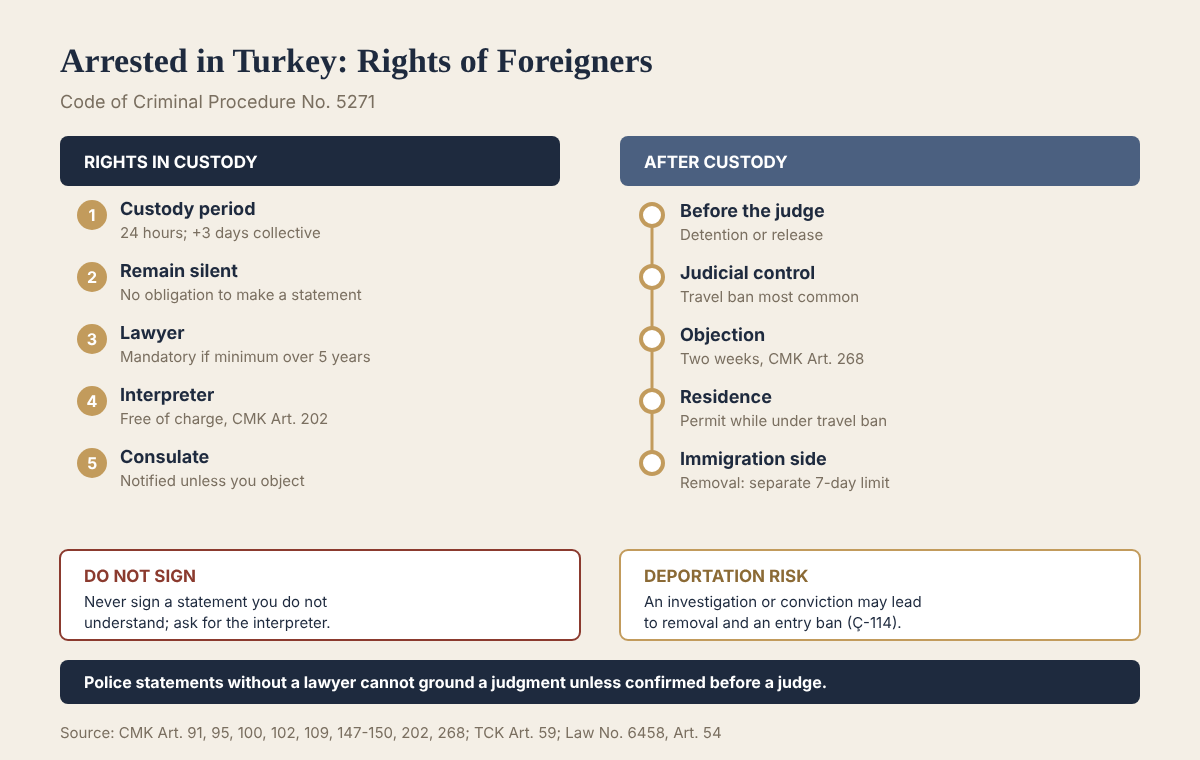
- Police custody may last up to 24 hours from the arrest; in collective offences, the prosecutor may extend it by one day at a time up to three more days.
- A suspect has the right to remain silent and the right to a lawyer at every stage; a lawyer is appointed automatically for offences punishable by a minimum of more than five years’ imprisonment.
- A foreigner who does not speak Turkish sufficiently is assisted by an interpreter appointed by the prosecutor or judge, free of charge (CMK, Article 202).
- If the person arrested is a foreigner, the consulate of his or her country is informed unless the person objects in writing (CMK, Article 95).
- Instead of pre-trial detention, the judge may impose judicial control measures; for foreigners, a travel ban (yurt dışına çıkış yasağı) is the most common.
- Criminal proceedings may lead to a removal decision and an entry ban under Law No. 6458, which must be challenged separately within seven days.
The first hours: arrest and custody
A person may be apprehended by the police under Article 90 of the CMK when caught in the act, or on the basis of a warrant. After apprehension, the public prosecutor decides whether to release the person or to keep him or her in custody (gözaltı) for the investigation. Under Article 91, custody requires that the measure is necessary for the investigation and that there is concrete evidence indicating that the person committed a crime.
Code of Criminal Procedure No. 5271, Article 91(1) and (3) (unofficial translation)
(1) If the person apprehended under the above article is not released by the Public Prosecutor’s Office, it may be decided to take the person into custody to complete the investigation. The custody period may not exceed twenty-four hours from the moment of apprehension, excluding the time necessary to send the person to the judge or court nearest to the place of apprehension. (…) (3) In offences committed collectively, due to difficulty in collecting evidence or the large number of suspects, the public prosecutor may order in writing that the custody period be extended for three days, each time not exceeding one day.
The suspect and the relatives, as well as the lawyer, may challenge the custody decision or the extension order before the criminal judgeship of peace (sulh ceza hakimliği), which decides immediately (Article 91(5)). Separate rules apply to certain terrorism-related offences.
Notification of relatives and the consulate
Under Article 95, a relative or a person chosen by the suspect is informed without delay of the apprehension and of any extension of custody, by order of the prosecutor. If the person apprehended is a foreigner, the consulate of the country of nationality is notified unless the person objects in writing. This reflects Article 36 of the Vienna Convention on Consular Relations, to which Turkey is a party. Consular officers may visit the person, help to find a lawyer and contact the family, but they cannot represent the person in the proceedings or secure release.
Rights during questioning
The rights of a suspect are set out in Article 147 of the CMK. Before the statement is taken, the suspect must be informed of the accusation and of the following rights:
- Right to remain silent: the suspect is not obliged to make any statement about the accusation.
- Right to a lawyer: the suspect may choose a lawyer, and if he or she cannot afford one, a lawyer is appointed by the bar association on request (Article 149). For offences punishable by a minimum of more than five years’ imprisonment, a lawyer is appointed automatically even without a request (Article 150(3)). The lawyer may meet the suspect privately at any time.
- Right to request evidence: the suspect may ask for specific evidence to be collected in his or her favour.
- Prohibited methods: ill-treatment, torture, deception, threats and promises of unlawful benefits are prohibited. Statements obtained in this way cannot be used as evidence, even with the suspect’s consent (Article 148).
- Police statements: a statement taken by the police without a lawyer cannot be used as the basis of a judgment unless confirmed by the suspect before a judge or court (Article 148(4)).
The right to an interpreter
Code of Criminal Procedure No. 5271, Article 202(1) and (3) (unofficial translation)
(1) If the accused or the victim does not know Turkish sufficiently to express himself or herself, the essential points of the accusation and the defence at the hearing shall be translated through an interpreter appointed by the court. (…) (3) The first and second paragraphs also apply to the suspect, victim or witnesses heard during the investigation stage. At this stage the interpreter is appointed by the judge or public prosecutor.
The interpreter appointed by the authorities is paid by the State; the suspect is not charged for it, in line with Article 6(3)(e) of the European Convention on Human Rights. The suspect should not sign a statement that he or she does not understand. If the translation is inadequate, the lawyer should object and ask for this to be recorded in the minutes.
Before the judge: detention or release
At the end of custody, the prosecutor either releases the suspect, with or without a request for judicial control, or brings him or her before the criminal judgeship of peace with a request for pre-trial detention (tutuklama). Under Article 100, detention may be ordered only where there is strong suspicion of a crime and a ground for detention, such as a risk of flight or of tampering with evidence, and where detention is proportionate. For certain serious offences listed in the article, the ground for detention may be presumed to exist.
Foreigners are often regarded as presenting a higher risk of flight because they have ties abroad. This is a matter that the defence must address directly, by presenting evidence of residence, family, employment and property in Turkey, and by proposing alternatives such as a travel ban, regular reporting to the police or a security deposit.
Judicial control and travel bans
Article 109 lists the judicial control measures that may be imposed instead of detention. They include a prohibition on leaving the country, an obligation to report regularly to a police station, the deposit of a security, house arrest and electronic monitoring. For foreigners, the travel ban is by far the most frequently used measure. It can last until the end of the trial, which may take months or years.
A foreigner subject to a travel ban must have a lawful basis for staying in Turkey during that time. The migration authorities may issue a short-term residence permit on the ground that the person must remain in Turkey at the request or decision of judicial authorities (Law No. 6458, Article 31(1)(g)). The foreigner should apply for this permit promptly, since otherwise the stay may become irregular. The travel ban can be challenged by objection in the same way as a detention decision, and an application to lift it can be made at any stage, for example when the investigation has progressed and the risk of flight has decreased.
Challenging detention
The detention decision and the rejection of a request for release can be challenged by objection (itiraz) within two weeks of the date on which the decision was learned (Article 268). Since the 2021 amendments made by Law No. 7331, objections against detention and judicial control decisions of the criminal judgeship of peace are examined by the judge of the criminal court of first instance (asliye ceza mahkemesi). The detained person can apply for release at any time, and the continuation of detention must be reviewed at regular intervals of no more than thirty days during the investigation. After the ordinary remedies have been exhausted, an individual application can be made to the Constitutional Court on the ground of violation of the right to liberty and security. The maximum period of detention depends on the offence: in cases outside the jurisdiction of the assize courts, it is one year, extendable by six months; for cases within the jurisdiction of the assize courts, it is two years, extendable up to three more years (Article 102).
Trial and judgment
If the prosecutor files an indictment, the case is heard by the criminal court of first instance or the assize court, depending on the offence. The accused has the right to attend the hearings, to be represented by a lawyer, to examine evidence and witnesses, and to make the final defence. Under Article 202(4), the accused may also make the oral defence in another language in which he or she can express himself or herself better, with an interpreter chosen from the official list, but in that case the cost of that interpreter is not covered by the State.
The judgment can be appealed to the regional court of appeal (istinaf) and, for more serious cases, to the Court of Cassation (Yargıtay). A conviction may lead to imprisonment, a judicial fine, a suspended sentence or deferral of the announcement of the verdict (hükmün açıklanmasının geri bırakılması), depending on the sentence and the circumstances.
Foreigners sentenced to imprisonment in Turkey may in certain cases apply to serve the sentence in their country of nationality under the Council of Europe Convention on the Transfer of Sentenced Persons, to which Turkey is a party, or under a bilateral agreement, and under the International Judicial Cooperation in Criminal Matters Law No. 6706.
Immigration consequences
A criminal case affects the foreigner’s immigration status in several ways:
- Removal after sentence: under Article 59 of the Turkish Criminal Code, the authorities are notified for removal proceedings after a foreigner sentenced to imprisonment is released on probation or completes the sentence. Removal is then decided under Article 54(1)(a) of Law No. 6458.
- Threat to public order: an ongoing investigation or prosecution may be relied on as a ground for removal on the basis of a threat to public order or public security under Article 54(1)(d), even before a final judgment.
- Residence permit: a residence permit may be cancelled or not renewed on public order grounds.
- Entry ban codes: criminal proceedings are often recorded with a restriction code, commonly Ç-114, which prevents re-entry after departure. See our guide on Turkey entry ban codes.
A removal decision must be challenged before the administrative court within seven days of notification. These proceedings are separate from the criminal case and must be handled in parallel; see our guide on deportation from Turkey. An acquittal or a decision not to prosecute is strong evidence in support of an application to lift a restriction code.
A foreigner who has been the subject of criminal proceedings is often recorded under code Ç-114. Where the case ends with a decision not to prosecute or an acquittal, that decision is the main basis for an application to lift the code; see our Turkish-language guide on the Ç-114 restriction code.
What to do if you or a family member is arrested
- Stay calm, and do not resist or argue with the police.
- State clearly that you want a lawyer and an interpreter, and that you want your consulate to be informed if you wish.
- Do not sign any document you do not understand.
- Use the right to remain silent until you have spoken with a lawyer.
- Family members should contact a lawyer, who can attend the police station and the courthouse and obtain information about the file, subject to any restriction order.
- Keep documents showing residence, employment and family ties in Turkey ready, as they are important when the judge decides on detention.
Frequently asked questions
How long can the police hold me without bringing me before a judge?
In general, 24 hours from apprehension, plus the time needed to bring you to the nearest judge (not more than 12 hours). In collective offences, the prosecutor may extend custody by one day at a time up to three more days.
Will I get an interpreter if I do not speak Turkish?
Yes. The prosecutor or judge appoints an interpreter during the investigation, and the court appoints one for the hearings. The State pays for the interpreter it appoints.
Will my embassy be informed?
Yes, the consulate of your country is notified of your arrest unless you object in writing.
Can I leave Turkey while my criminal case continues?
Only if there is no travel ban. If a travel ban is imposed, you must remain in Turkey until it is lifted, and you should obtain a residence permit for that period.
Will a criminal case lead to deportation?
Not automatically, but it may. An investigation or a conviction can be used as a ground for removal and for an entry ban. The immigration side should be managed by a lawyer in parallel with the criminal defence.
Legislation: Code of Criminal Procedure No. 5271, Articles 90, 91, 95, 100, 101, 102, 109, 147-150, 202 and 268; Turkish Criminal Code No. 5237, Article 59; Law No. 6458, Articles 31(1)(g) and 54; Vienna Convention on Consular Relations, Article 36; European Convention on Human Rights, Articles 5 and 6.
Legal assistance in Istanbul
Karatay Law Office advises and represents foreign nationals before Turkish courts, public prosecutors and administrative authorities, with an office opposite the Istanbul Courthouse (Çağlayan) in Şişli. For contact details and the areas in which we assist international clients, see our page Lawyer in Şişli, Istanbul.
Other guides for foreigners in Turkey
- Residence Permit in Turkey: Types, Requirements, Refusal and Appeal (2026 Guide)
- Turkish Citizenship by Investment: USD 400,000 Property Route and Other Options (2026)
- Buying Property in Turkey as a Foreigner: Legal Steps, Restrictions, Taxes and Risks
- Deportation from Turkey: Grounds, Administrative Detention and the 7-Day Appeal
- Turkey Entry Ban and Restriction Codes (Ç-114, G-87, N-82): Meaning and How to Lift Them
- Work Permit in Turkey for Foreigners: Types, Application, Turquoise Card and 2026 Fines
- Divorce in Turkey for Foreigners and Recognition of Foreign Divorce Judgments
- Inheritance in Turkey for Foreigners: Applicable Law, Certificate of Inheritance and Taxes
- Renting in Turkey as a Foreigner: Tenant Rights, Rent Increases, Deposit and Eviction
This article provides general information on Turkish law as of October 2026 and does not constitute legal advice. Legislation and administrative practice change frequently; legal assistance should be obtained for a specific case.