
 Av. Emrah Karatay
Many foreign nationals learn at the airport, or when a residence permit is refused, that a “code” has been recorded against them in the Turkish immigration system. These restriction codes (tahdit kodları) are internal administrative records that bar entry, require prior permission, or flag a person for further checks. They are not listed in any statute, and the meaning commonly attributed to them online is not always accurate. This guide explains the legal basis of entry bans in Turkey, the main code families, how long a ban may last, how to find out what has been recorded and the legal routes for having a ban lifted or annulled.
SHORT ANSWER
- The legal basis for entry bans is Article 9 of Law No. 6458; refusal of entry at the border is regulated by Article 7.
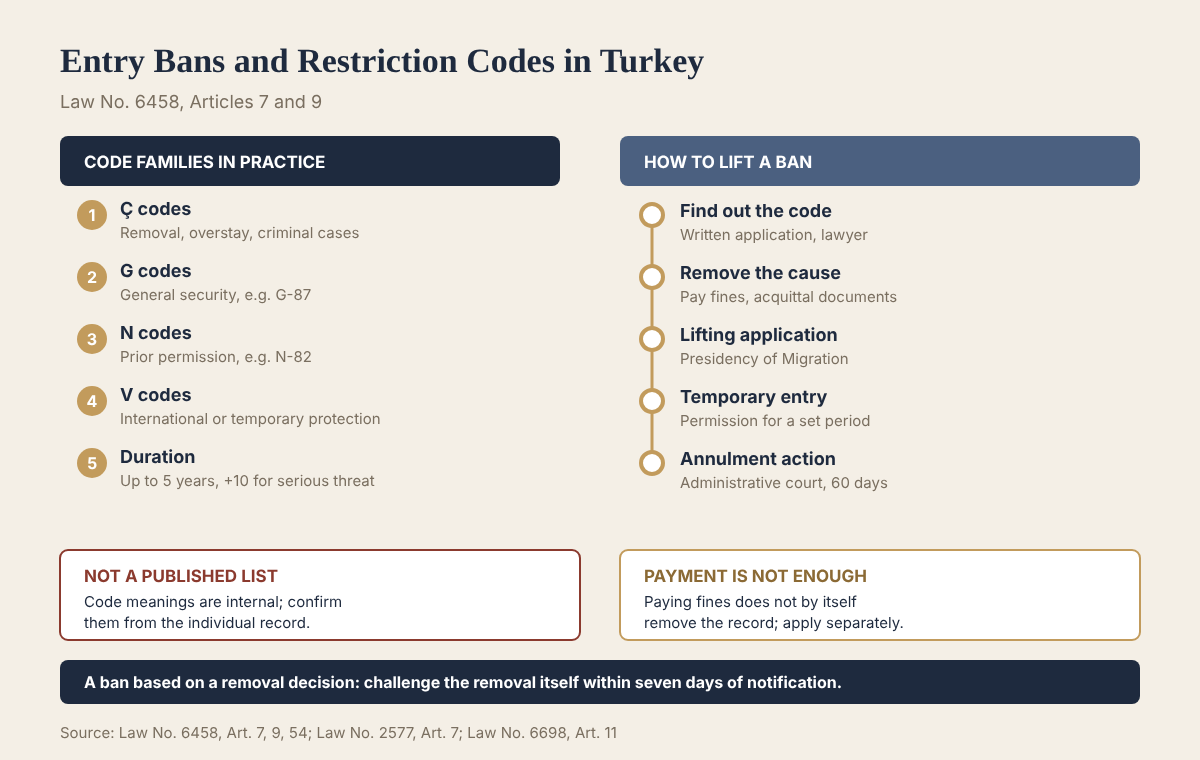
- An entry ban may last up to five years; where there is a serious threat to public order or public security, it may be extended by up to ten more years.
- Codes are internal records; the letter usually indicates the category (for example Ç for removal and overstay cases, G for general security, N for prior permission, V for international or temporary protection).
- The Presidency of Migration Management may lift an entry ban, or allow entry for a specific period without lifting it.
- An entry ban is an administrative act and may be challenged before the administrative court, generally within sixty days of the date on which the person learns of it.
- Paying outstanding fines and fees does not by itself remove a code; a separate application is usually needed.
Legal basis of entry bans
Article 9 of Law No. 6458 on Foreigners and International Protection gives the Presidency of Migration Management the power to ban the entry of foreigners whose entry into Turkey is considered objectionable for reasons of public order, public security or public health, where necessary after obtaining the opinion of the relevant public institutions. The entry of foreigners removed from Turkey is banned by the Presidency or by the governorships.
Law No. 6458, Article 9(1)-(3) (unofficial translation)
(1) The Directorate General may, where necessary by obtaining the opinions of relevant public institutions and organisations, ban the entry into Turkey of foreigners whose entry is deemed objectionable in terms of public order, public security or public health. (2) The entry into Turkey of foreigners who are removed from Turkey shall be banned by the Directorate General or the governorships. (3) The duration of the entry ban shall not exceed five years. However, where there is a serious threat to public order or public security, this period may be extended by the Directorate General for a maximum of ten more years.
The functions referred to as the Directorate General are now carried out by the Presidency of Migration Management. Separately, under Article 7 the border authorities refuse entry to foreigners who do not hold a valid passport or visa, who are subject to an entry ban, or who are considered a threat, among other grounds. Refusal at the border and an entry ban are therefore different measures, although in practice both are triggered by the same records.
Entry bans are also imposed as a consequence of overstaying. A foreigner who stays beyond the period allowed by the visa, the visa exemption or the residence permit may receive an entry ban depending on the length of the overstay and on whether the person left voluntarily before being detected by the authorities. In practice, the durations applied range from one month to five years. A foreigner who leaves voluntarily and pays the violation fee and any fines usually receives a shorter ban, and a short overstay may not lead to any ban at all.
Main code families
The codes are not published in an official list, and the Presidency does not confirm their meaning publicly. The descriptions below reflect how the codes are generally used in practice and in court decisions. The exact meaning and legal basis of the code recorded in a particular case should always be confirmed from the individual administrative file.
| Code family | General meaning in practice | Typical effect |
|---|---|---|
| Ç codes (for example Ç-101 to Ç-105, Ç-114, Ç-135) | Removal decisions, visa and residence violations, criminal proceedings, unpaid fines or fees | Entry ban for a set period, or until the underlying issue is resolved |
| G codes (for example G-87) | General security; the person is considered a threat to public security | Entry ban, often without a fixed end date, until lifted by the administration or annulled by a court |
| N codes (for example N-82) | Entry subject to prior permission of the authorities | Not formally a ban, but entry and residence applications are refused unless permission is obtained |
| V codes (for example V-87) | International protection or temporary protection cases, including persons who returned to their country | Entry ban or need for prior permission, depending on the case |
| O and other codes | Various administrative records, such as health-related restrictions or document issues | Depends on the specific code |
Ç-114
Ç-114 is widely reported as a code used for foreigners who are the subject of criminal proceedings or who were removed for reasons connected with a criminal investigation. It is often accompanied by the cancellation of existing permits. Where the criminal proceedings end with an acquittal, a decision not to prosecute, or a dismissal, the foreigner can rely on that outcome to apply for the removal of the code.
G-87
G-87 is generally understood as a general security code, applied where the authorities consider that the person poses a threat to public security, often based on intelligence information. Because the information is frequently classified, the person may not be told the reasons. Courts have nevertheless held that the administration must present the information on which the decision is based to the court, and decisions based only on a general reference to security, without concrete facts, have been annulled.
N-82
N-82 means that entry into Turkey, and in practice the grant of a residence permit, is subject to prior permission. The administration has argued before the courts that N-82 is not an entry ban but only a permission requirement. In practice, however, persons with this code are frequently refused at the border or refused residence permits, so the code operates as a de facto ban. It may be challenged in the same way as an entry ban.
How to find out whether you have a code
A foreigner may learn of a code at the border, through a refused visa or residence permit application, or through a notification of a removal decision. Where no decision has been notified, the person or a lawyer with a power of attorney can submit a written application to the Presidency of Migration Management asking whether any restriction has been recorded, its basis and its duration. Under the right to information and the right of access to personal data under the Personal Data Protection Law No. 6698, the person is entitled to request information on the records held, subject to the exceptions for national security.
The answer should state the code, the date and the legal basis. This is important because the time limit for bringing a court case runs from the date on which the person learns of the decision, and because the remedy depends on the type of code.
How to have an entry ban lifted
Administrative application
Article 9 allows the Presidency of Migration Management to lift an entry ban, or to allow the foreigner to enter Turkey for a certain period without lifting the ban. An application for lifting the ban is usually based on one or more of the following:
- the reason for the ban no longer exists, for example the criminal case has ended with an acquittal or the fines have been paid;
- the foreigner has family ties in Turkey, such as a Turkish spouse or children;
- the foreigner needs to enter for humanitarian reasons, medical treatment, a court hearing or business reasons;
- the ban is disproportionate in relation to the violation.
The application should be supported by documents, such as court decisions, receipts showing payment, marriage and birth certificates or employment documents. Where a removal decision was taken, the costs of removal may also need to be paid.
Annulment action before the administrative court
An entry ban, and a code that operates as a ban, is an administrative act. It can be challenged by an action for annulment before the administrative court in Ankara or in the place where the decision was taken, generally within sixty days of notification or of the date on which the person learned of it, under Law No. 2577 on Administrative Procedure. The claimant can ask for a stay of execution.
The court examines whether the ban has a lawful basis, whether the facts relied on are proven, whether the reasons were disclosed and whether the ban is proportionate, taking account of the right to respect for family life under Article 8 of the European Convention on Human Rights and Article 20 of the Constitution. If the court annuls the ban, the administration must remove the record. If the court rejects the action, an appeal (istinaf) to the regional administrative court is available.
Relationship with a removal decision
If the entry ban is based on a removal decision, the removal decision itself must be challenged within seven days of notification. Once that time limit has passed, the removal decision becomes final, but the entry ban can still be challenged on the ground that its duration is disproportionate or that the circumstances have changed. The removal process is explained in our guide on deportation from Turkey.
Individual codes explained
Each frequently encountered code is explained in detail in a separate Turkish-language guide, covering its legal basis, typical duration, the evidence the administration must show and the routes for having it lifted. Ç-138 is particularly important in practice: it is recorded when a person tries to enter Turkey while an earlier ban is still in force, and it is generally reported to carry a five-year ban, so the end date of any existing ban should be confirmed before travelling.
- Full list of restriction codes (tahdit kodları listesi)
- Ç-101 to Ç-105: overstay bans of three months to five years
- Ç-113: illegal entry or exit
- Ç-114: criminal proceedings
- Ç-116: public morality, public order, unlawful means of living
- Ç-117, Ç-118, Ç-119: unauthorised work and unpaid fines
- Ç-138: attempting to enter despite a ban
- Ç-141: international security
- Ç-149: public security assessment at the border
- Ç-152: precautionary entry ban
- G-26: suspected links to unlawful organisations
Entering Turkey with a ban: what not to do
A foreigner who attempts to enter Turkey despite an entry ban, for example through irregular border crossings or with a different passport, commits a further violation and becomes subject to removal under Article 54. Such attempts also make later applications to lift the ban much harder. Applications for a new passport with a different name or nationality do not remove biometric records, which are matched at the border.
Frequently asked questions
How long does an entry ban to Turkey last?
Up to five years under Article 9(3). Where there is a serious threat to public order or public security, it may be extended by up to ten more years. Bans imposed for overstays usually range from one month to five years depending on the length of the overstay.
Does paying my overstay fine remove the code?
Not necessarily. Payment is often a condition for lifting a code, but the record is usually removed only after an application or after the ban period ends.
Is N-82 an entry ban?
Formally it is a requirement for prior permission, but in practice persons with this code are often refused entry or residence permits. It can be challenged before the administrative court.
Can I enter Turkey for a court hearing or a family emergency while banned?
Article 9 allows the Presidency to permit entry for a specific period without lifting the ban. An application with supporting documents should be made in advance.
Can a lawyer in Turkey act for me while I am abroad?
Yes. A power of attorney can be signed before a Turkish consulate or before a notary abroad with an apostille, after which a lawyer can obtain information, apply to the Presidency and bring an action before the administrative court.
Legislation: Law No. 6458 on Foreigners and International Protection, Articles 7, 9, 54 and 102; Law No. 2577 on Administrative Procedure, Article 7; Personal Data Protection Law No. 6698, Article 11; Constitution of the Republic of Turkey, Article 20; European Convention on Human Rights, Article 8.
Legal assistance in Istanbul
Karatay Law Office advises and represents foreign nationals before Turkish courts, public prosecutors and administrative authorities, with an office opposite the Istanbul Courthouse (Çağlayan) in Şişli. For contact details and the areas in which we assist international clients, see our page Lawyer in Şişli, Istanbul.
Other guides for foreigners in Turkey
- Residence Permit in Turkey: Types, Requirements, Refusal and Appeal (2026 Guide)
- Turkish Citizenship by Investment: USD 400,000 Property Route and Other Options (2026)
- Buying Property in Turkey as a Foreigner: Legal Steps, Restrictions, Taxes and Risks
- Deportation from Turkey: Grounds, Administrative Detention and the 7-Day Appeal
- Work Permit in Turkey for Foreigners: Types, Application, Turquoise Card and 2026 Fines
- Divorce in Turkey for Foreigners and Recognition of Foreign Divorce Judgments
- Inheritance in Turkey for Foreigners: Applicable Law, Certificate of Inheritance and Taxes
- Renting in Turkey as a Foreigner: Tenant Rights, Rent Increases, Deposit and Eviction
- Arrested in Turkey as a Foreigner: Rights in Custody, Detention, Travel Bans and Deportation Risk
This article provides general information on Turkish law as of October 2026 and does not constitute legal advice. Legislation and administrative practice change frequently; legal assistance should be obtained for a specific case.